
Through the mediating function of access to resources (AR), this study investigates the effects of digital transformation, human capital, social capital, and business model innovation (BMI) on the firm performance of Vietnamese firms. The study analyses survey data from 394 Vietnamese businesses in a variety of industries using Partial Least Squares Structural Equation Modelling (PLS-SEM). The results show that BMI and digital transformation are strongly impacted by social and human capital. Furthermore, digital transformation significantly improves business performance and BMI. Additionally, the study finds AR's partial mediation role in the connections among digital transformation, human capital, and social capital. The study integrates Social Capital Theory and Human Capital Theory while providing empirical evidence, contributing to an enhanced understanding of factors driving firm performance in the context of digital transformation. The findings offer practical insights for business managers and policymakers in developing strategies to enhance operational efficiency through digital transformation and business model innovation.
Introduction
The study of digital transformation (DT) in enterprises has garnered significant attention from researchers worldwide. Li et al. (2018) examined the digital transformation phenomenon in relation to small and medium-sized businesses (SMEs). The adoption of digital transformation by SMEs is aimed at fostering business model innovation (BMI), which consequently enhances organizational performance (Bouwman et al., 2019). Digital transformation also influences innovation in tourism enterprises (Sinno, 2019). Additionally, the proficiency in information technology contributes to improved organizational performance via the intermediary function of digital transformation (Nwankpa & Roumani, 2016). The digital revolution offers a chance to develop new company strategies. Businesses' digital transformation has increased because of the COVID-19 pandemic). Lastly, the digital revolution has encouraged creativity and entrepreneurship (Nambisan et al., 2019).
Additionally, digital transformation through managerial capital and external resource support has gained increasing attention from scholars in recent years. Nguyen Thi Thuy Quynh et al. (2023) found a positive relationship between social capital and digital transformation, mediated by resource accessibility and human capital. Similarly, Tran et al. (2023) conducted a comprehensive re-evaluation of the influence of social capital on the process of digital transformation, specifically emphasizing the mediating effect of access to external resources. Four key factors support the digital transformation process, including human, technology, organization, and environment, with the environmental factor being considered the most critical criterion. Heubeck (2023) argued that the managerial human capital, including leadership and business skills, serves as a crucial enabler of digital transformation and contributes to improved business performance.
Several theoretical frameworks have been employed in previous studies. For instance, Clausen and Molden (2024) utilized Human Capital Theory to explain business model innovation through resources from the startup ecosystem and incubator communities. Nwankpa and Roumani (2016) applied Resource-Based Theory to examine the mediating role of digital transformation in the relationship between IT capability and firm performance. Additionally, Li et al. (2018) suggested that Dynamic Managerial Capabilities Theory is particularly useful in explaining the digital transformation of small and medium-sized enterprises (SMEs). The literature review highlights the crucial role of digital transformation in driving business innovation (Nwankpa & Roumani, 2016; Nambisan et al., 2019; Sinno, 2019). Additionally, digital transformation creates significant opportunities for business model innovation (Priyono et al., 2020). However, most small and medium-sized enterprises (SMEs) face limitations in capabilities and resources, making independent digital transformation challenging. Through managerial social networks, enterprises can leverage external support to facilitate digital transformation and innovate their business models in response to market changes (Li et al., 2018).
Overall, these relationships have garnered significant attention from researchers (Awwad et al., 2019). However, the extensive interplay among social capital, managerial human capital, resource accessibility, digital transformation, business model innovation, and organizational performance is notably underexplored, especially within emerging markets like Vietnam. Moreover, the intermediary function of resource accessibility in the context of social capital, human capital, and digital transformation has predominantly been neglected in prior research endeavor. Ultimately, a limited number of scholarly investigations have concurrently analyzed the influence of social capital, human capital, digital transformation, and business model innovation on firm performance in Vietnam, while integrating the mediating function of resource accessibility within a unified theoretical framework. Therefore, further research is needed to clarify these relationships, especially in dynamic, diverse, complex, and technology-driven environments.
In order to fill the research gap, this study examines the relationships between digital transformation, business model innovation, human capital, social capital, and firm performance in the Vietnamese setting, with a focus on the mediating role of resource accessibility. To achieve this objective, the following research questions (RQ) are proposed:
RQ 1: To what extent do social capital and human capital impact the digital transformation processes of enterprises within the context of Vietnam?
RQ 2: To what extent does the accessibility of resources act as a mediator in the interplay among social capital, human capital, and digital transformation within Vietnamese enterprises?
RQ 3: To what extent does digital transformation facilitate innovation in business models and enhance organizational performance within Vietnamese enterprises?
This study uses social capital, human capital, and resource accessibility to explain the process of digital transformation and business model innovation in enterprises in the context of Vietnam. It does this by building upon and integrating foundational theories, such as Social Capital Theory and Human Capital Theory, in order to address the three research questions. The study surveys 394 managers from various enterprises in Vietnam. Subsequent to the introductory segment, the research is organized into the subsequent sections: literature review, methodology, results, discussion, and conclusion.
Literature Review
Theoretical frameworks pertaining to Social Capital have been examined across multiple strata, encompassing the individual dimension , organizational level (Nahapiet & Ghoshal, 1998), and societal level . Social Capital Theory refers to the network of relationships that create or lead to resources that can be utilized for individual or collective benefit. In the present research, social capital is analyzed from an individual perspective. At this particular level, social capital is characterized as the resources inherent in an individual's interpersonal relationships with others. It includes the tangible or prospective advantages that an individual derives from both their formal and informal social networks.
Human Capital Theory
Human capital constitutes a pivotal factor in the prosperity of organizations. It is imperative for the recognition and formulation of entrepreneurial opportunities (Marvel, 2013), the utilization of these opportunities , the assimilation of novel knowledge, and the cultivation of competitive advantages for corporations. Human capital theory, as articulated by delineates the distinction between general human capital, which encompasses education and experiential learning, and specific human capital, which pertains to business acumen and managerial expertise. This theoretical framework underscores the notion that personal attributes exert a considerable influence on organizational operations. Marvel (2013) delineated human capital into two distinct categories: human capital investment, which encompasses education, experiential training, and recruitment processes, and human capital outcomes, which refer to the acquisition of knowledge, skills, and competencies. Competencies are cultivated through systematic training, the accumulation of experience, or an integration of educational pursuits with practical implementation.
Hypotheses Development
In a volatile organizational landscape, firms depend on the social capital possessed by managers to effectively address and overcome adversities . In transitional economies, where institutions (laws) remain weak and information lacks transparency, managerial social capital plays a crucial role (Peng & Luo, 2000). Managerial networks provide access to essential resources that support business survival and growth. Through the mechanisms of managerial social capital, organizations are afforded enhanced access to information and external resources, thereby facilitating their processes of digital transformation. Kane (2019) emphasized the importance of both internal and external collaboration in driving digital innovation. Social relationships—both within and outside the organization—enable employees and leaders to share knowledge and experiences, thereby accelerating the implementation of digital transformation initiatives. Empirical evidence from Nguyen Thi Thuy Quynh et al. (2023) further confirms that social capital positively influences firms’ digital transformation processes.
H1. Social capital has a positive impact on digital transformation.
IT capability is essential for effectively implementing digital transformation strategies (Aral & Weill, 2007; Mithas et al., 2013). Firms that develop strong IT capabilities enable higher levels of digital transformation across their products, services, and other value chain activities . Organizations possessing advanced IT competencies have the potential to propel digital transformation through the reengineering of current business processes and the transmutation of conventional customer products and services into digital alternatives (Nwankpa & Roumani, 2016). Digital transformation requires that firms possess digital competencies and digital management resources. Thus, enterprises must enhance their human capital to accelerate the digital transformation. Additionally, successful digital transformation demands the development of a business-oriented workforce and organizational capabilities (Li et al., 2018).
H2: Human capital is positively related to digital transformation.
From an individual's social capital, various resources can be accessed across different dimensions. According to the Resource-Based View (RBV), resources encompass all types of tangible and intangible assets, such as financial capital, raw materials, labor, technology, and organizational capabilities. Ju et al. (2019) identified key resources accessed through networks, including financial capital, raw materials, technology, and human capital. Startups often rely on external resources for successful establishment and growth. Specifically, entrepreneurial resource accessibility involves financial capital, knowledge, information, and additional partnerships (Semrau & Werner, 2014). Digital transformation requires substantial external resource support. In their early stages, businesses often lack sufficient operational resources (Tran Nha Ghi et al., 2021). Similarly, Li et al. (2018) highlighted that SMEs face significant resource and capability constraints in pursuing digital transformation. Therefore, leveraging social networks to connect with government agencies, support organizations, and digital service providers is essential for accessing critical resources that enable digital transformation. These readily available resources encompass knowledge, specialized skills, and monetary assets (Le et al., 2006; Le & Nguyen, 2009; Semrau & Werner, 2014; Tran Nha Ghi et al., 2021). Consequently, the availability of resources is anticipated to serve as a mediating factor in the interplay among social capital, human capital, and digital transformation.
H4: Access to resources functions as a mediating variable in the association between human capital and digital transformation.
Digital transformation enables organizations to leverage data connectivity, information, and knowledge (Nwankpa & Roumani, 2016). It enhances business model processes, allowing firms to optimize operations through external networks created using digital technologies. These networks facilitate improved supply chains, knowledge transfer, and operational efficiency. A crucial capability for digital transformation is the ability to design and implement new business models. Firms must continuously explore innovative ways to generate revenue, optimize cost structures, and maintain competitive positions within their industries. Digital transformation of business models includes expanding distribution channels, marketing, sales, and customer service through digital technologies. By adopting digital transformation, enterprises can redesign their business models to better align with market demands, reduce costs, and enhance performance.
H5. Digital transformation has a positive impact on business model innovation.
Digital transformation enhances the efficiency of business processes by automating repetitive tasks, minimizing errors, accelerating processing speed, and improving productivity. The adoption of digital technologies enables firms to explore and expand into new markets, improve customer service, and enhance accessibility to potential customers through digital channels. Research by Matt et al. (2015) indicates that enterprises implementing digital transformation effectively tend to achieve higher revenue growth than those that do not adopt digital technologies. Rapid digitalization enables businesses to seize market opportunities, optimize processes, and develop innovative products and services to meet customer demands. demonstrated that automation through digital technologies enhances firm performance (Koryachko et al., 2017). Additionally, as digital transformation increases, businesses can improve service quality, enhance customer satisfaction, and reduce sales costs (Mithas et al., 2016).
H6. Digital transformation has a positive impact on firm performance.
Business model innovation (BMI) enables firms to exploit new market opportunities (Zott & Amit, 2015). By restructuring processes and adopting digital technologies, businesses can enhance operational efficiency, reduce operating costs, and optimize resources (Zott & Amit, 2017). BMI contributes to higher productivity, profitability, and market value (Andreini & Bettinelli, 2017) while also improving financial performance (Pedersen & Sornn-Friese, 2015). Firms implementing BMI achieve four times the profitability compared to those focusing solely on product or service innovation (Bashir & Verma, 2017). Moreover, businesses that adopt BMI tend to achieve superior performance compared to those that do not (Futterer et al., 2018).
H7. Business model innovation (BMI) has a positive impact on firm performance.
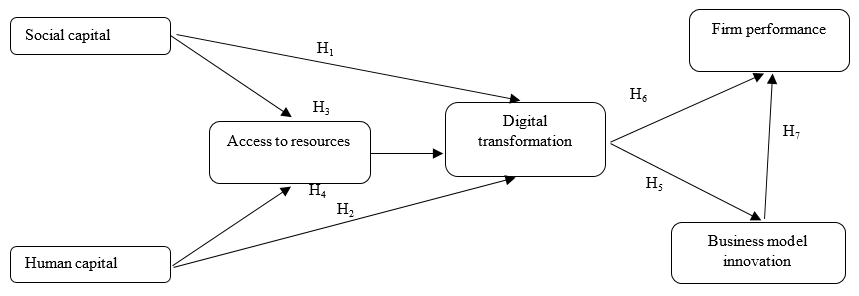
The suggested research paradigm is shown in Figure 1 and is based on the theoretical explanations and the formulation of research hypotheses.
|
|
|
Figure 1. Research model |
Materials and Methods
Research Process
The study employs a mixed-method approach, incorporating qualitative research, preliminary quantitative research, and formal quantitative research. Qualitative and preliminary quantitative research involve interviews with five experts, including CEOs and vice presidents of enterprises. The measurement scales used in this study are refined through expert interviews to ensure their appropriateness for the research context. Following the qualitative phase, a pilot survey is conducted with 105 enterprise executives to assess the reliability and convergent validity of the measurement scales.
With a sample size of N = 5000, the study employs bootstrapping to investigate the stated research hypotheses empirically. The measurement model and the structural model are both examined using this methodological technique. Scale reliability, composite reliability, convergent validity, and discriminant validity are analyzed in order to assess the measurement model. Cronbach's alpha and Composite Reliability (CR) coefficients need to be higher than 0.6 in order to guarantee reliability (Hair Jr et al., 2019). The Average Variance Extracted (AVE) for each construct must be greater than 0.5, following Hair Jr et al. (2019). Discriminant validity is evaluated in accordance with the criterion established by Fornell and Larcker (1981) criterion, which necessitates that the square root of the Average Variance Extracted (AVE) for each construct exceeds its correlation coefficients with other constructs present within the model. The structural model is assessed using the following criteria: Coefficient of Determination (R²): Model explanatory power is classified based on Cohen (2013): Weak: R² = 0.02; Moderate: R² = 0.16; Strong: R² = 0.26. Predictive Relevance (Q²) evaluated using the Stone-Geisser criterion Henseler et al. (2009): Weak prediction: Q² < 0.02; Moderate prediction: 0.02 ≤ Q² ≤ 0.35; Strong prediction: Q² > 0.35. Effect Size (f²): The magnitude of effects between variables follows Henseler et al. (2009): Weak effect: f² = 0.02; Moderate effect: f² = 0.15; Strong effect: f² = 0.35.
Data
The study employs a non-probability sampling method (convenience sampling). Each enterprise designates one representative, either a senior or mid-level manager, to participate in the survey. Data collection will be conducted through online questionnaires or face-to-face interviews, depending on respondent convenience and practical conditions. Thus, data will be gathered through two main channels: online and offline. The combination of both methods aims to maximize accessibility and optimize data collection from the target respondents.
Measures
The research model includes six constructs, with key concepts such as social capital, digital transformation, and business model innovation. Social capital is measured using four observed variables, adapted from Peng and Luo (2000). Human capital (HC) is measured using five observed variables, adapted from Volodymyr et al. (2021). Digital transformation is assessed with three observed variables, derived from Aral and Weill (2007). Business model innovation is measured using nine observed variables, based on Zott and Amit (2007). Access to resources (AR) is measured using three observed variables, adapted from (Semrau & Werner, 2014). Finally, Firm performance (FP) is assessed with five observed variables, based on (Ju et al., 2019). All observed variables are measured using a five-point Likert scale, where: (1) Strongly Disagree, (2) Disagree, (3) Neutral, (4) Agree, and (5) Strongly Agree.
Common Method Bias
As suggested by Kock (2015), the Variance Inflation Factor (VIF) is used to test for Common Method Bias (CMB). Table 1 presents the VIF values, all of which are below 3.3, indicating that the proposed research model does not suffer from CMB and is considered valid.
Results and Discussion
Sample Characteristics
Table 1. Sample characteristics
|
Category |
Sub-category |
Frequency |
Percentage |
|
Type of operation |
Private Enterprise |
80 |
20.30% |
|
Limited Liability Company (LLC) |
200 |
50.80% |
|
|
Joint-Stock Company |
90 |
22.80% |
|
|
Others |
24 |
6.10% |
|
|
Operating Time |
< 3 years |
50 |
12.70% |
|
3 - 5 years |
70 |
17.80% |
|
|
5 - 7 years |
90 |
22.80% |
|
|
7 - 10 years |
80 |
20.30% |
|
|
> 10 years |
104 |
26.40% |
|
|
Labour size |
<10 |
120 |
30.50% |
|
10 - 50 |
200 |
50.80% |
|
|
51 - 200 |
74 |
18.70% |
|
|
Revenue |
<3 billion VND |
110 |
27.90% |
|
3 - 50 billion VND |
210 |
53.30% |
|
|
50 – 200 billion VND |
74 |
18.80% |
|
|
Field of operation |
Manufacturing |
130 |
33.00% |
|
Services |
120 |
30.50% |
|
|
Trade |
100 |
25.40% |
|
|
Other |
44 |
11.20% |
The research sample consists of 394 small and medium-sized enterprises (SMEs), reflecting a diverse range of characteristics and accurately representing the structure of businesses in Vietnam (Table 1). Regarding business type, Limited Liability Companies (LLCs) account for the highest proportion (50.8%), followed by Joint-Stock Companies (22.8%). Private enterprises and other business types make up smaller portions (20.3% and 6.1%, respectively). In terms of years of operation, businesses operating for over 10 years hold the largest share (26.4%), while newly established firms (under 3 years) represent 12.7%, indicating a continued startup trend. Enterprises with 3 to 7 years of operation account for 40.6%, demonstrating a significant presence in the sample. Regarding firm size and revenue, most businesses fall into the small (50.8%) and micro (30.5%) categories, aligning with the SME classification. Revenue distribution reflects this trend, with small enterprises (annual revenue of 3–50 billion VND) making up 53.3%, while micro enterprises account for 27.9%. Lastly, in terms of industry, manufacturing firms constitute the largest proportion (33.0%), followed by service enterprises (30.5%) and trade businesses (25.4%). Firms in other industries account for 11.2%, indicating a diverse sample that allows for a comprehensive evaluation across multiple sectors.
Measurement Model Assessment
Table 2. Cronbach’s Alpha, Compose reliability, AVE
|
Outer loadings |
Cronbach's alpha |
Composite reliability |
AVE |
|
|
AR |
0.844 |
0.85 |
0.762 |
|
|
AR1 |
0.879 |
|||
|
AR2 |
0.895 |
|||
|
AR3 |
0.844 |
|||
|
BMI |
0.838 |
0.845 |
0.672 |
|
|
BMI1 |
0.786 |
|||
|
BMI2 |
0.863 |
|||
|
BMI3 |
0.802 |
|||
|
BMI4 |
0.827 |
|||
|
DT |
0.915 |
0.918 |
0.747 |
|
|
DT1 |
0.856 |
|||
|
DT2 |
0.862 |
|||
|
DT3 |
0.872 |
|||
|
DT4 |
0.885 |
|||
|
DT5 |
0.845 |
|||
|
HC |
0.882 |
0.892 |
0.68 |
|
|
HC1 |
0.866 |
|||
|
HC2 |
0.78 |
|||
|
HC3 |
0.85 |
|||
|
HC4 |
0.837 |
|||
|
HC5 |
0.787 |
|||
|
SC |
0.878 |
0.89 |
0.731 |
|
|
SC1 |
0.814 |
|||
|
SC2 |
0.876 |
|||
|
SC3 |
0.864 |
|||
|
SC4 |
0.864 |
|||
|
SMEP |
0.869 |
0.873 |
0.656 |
|
|
SMEP1 |
0.783 |
|||
|
SMEP2 |
0.825 |
|||
|
SMEP3 |
0.82 |
|||
|
SMEP4 |
0.837 |
|||
|
SMEP5 |
0.783 |
The data assesses the reliability and convergent validity of the six measurement scales—AR, BMI, DT, HC, SC, and SMEP—using Cronbach's alpha, Composite Reliability (CR) (Table 2). Cronbach's alpha values range from 0.838 to 0.915, exceeding the 0.7 threshold recommended by (Nunnally & Bernstein, 1994), indicating high internal reliability. Additionally, the Composite Reliability (CR) values for all constructs exceed 0.7, ranging from 0.891 to 0.937, confirming strong internal consistency of the measurement scales.
Based on Table 2, the Average Variance Extracted (AVE) ranges from 0.656 to 0.762, exceeding the 0.5 threshold recommended by (Fornell & Larcker, 1981), thereby confirming the convergent validity of the measurement scales. Overall, all scales meet the criteria set by (Hair Jr et al., 2017), AVE for adequate convergent validity, ensuring their suitability for use in structural equation modeling (SEM) analysis.
Table 3. Discriminant validity testing by Fornel-Larcker
|
AR |
BMI |
DT |
HC |
SC |
SMEP |
|
|
AR |
0.873 |
|||||
|
BMI |
0.311 |
0.82 |
||||
|
DT |
0.282 |
0.268 |
0.864 |
|||
|
HC |
0.362 |
0.283 |
0.278 |
0.825 |
||
|
SC |
0.276 |
0.213 |
0.231 |
0.279 |
0.855 |
|
|
SMEP |
0.378 |
0.393 |
0.317 |
0.487 |
0.535 |
0.81 |
Table 3 delineates the findings of the assessment of discriminant validity employing the Fornell-Larcker Criterion (Fornell & Larcker, 1981). The square root of the Average Variance Extracted (AVE) for each construct exceeds its correlation with any alternate construct within the model, thereby signifying that the measurement scales exhibit a robust level of discriminant validity.
Structural Model Evaluation
Table 4. Direct and indirect effects
|
Hypothesis |
Path |
β |
SD |
VIF |
T statistics |
P values |
Conclusion |
|
Direct effects |
|||||||
|
H1 |
SC -> DT |
0.132 |
0.048 |
1.127 |
2.763 |
0.006 |
Accepted |
|
H2 |
HC -> DT |
0.175 |
0.052 |
1.199 |
3.381 |
0.001 |
Accepted |
|
H5 |
DT -> BMI |
0.268 |
0.05 |
1.000 |
5.4 |
0.000 |
Accepted |
|
H6 |
DT -> SMEP |
0.229 |
0.049 |
1.077 |
4.669 |
0.000 |
Accepted |
|
H7 |
BMI -> SMEP |
0.331 |
0.048 |
1.077 |
6.856 |
0.000 |
Accepted |
|
Indirect effects |
|||||||
|
H4 |
HC -> AR -> DT |
0.056 |
0.019 |
|
3.042 |
0.002 |
Accepted |
|
H5 |
SC -> AR -> DT |
0.035 |
0.013 |
|
2.687 |
0.007 |
Accepted |
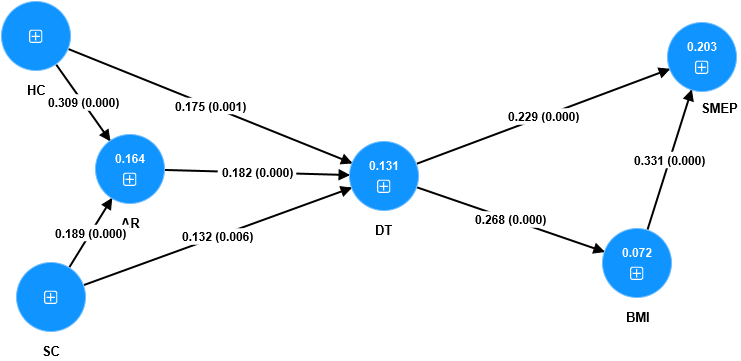
The results indicate that all relationships in the model are statistically significant (Table 4). Specifically, social capital (SC) has a positive effect on digital transformation (DT) with a beta coefficient (β) = 0.132 and p-value = 0.006, confirming that this impact is significant (H1 is supported). Similarly, human capital (HC) also significantly influences DT (β = 0.175, p-value = 0.001), supporting H2. Additionally, DT has a strong impact on business model innovation (BMI) (β = 0.268, p-value = 0.000), leading to the acceptance of H5. DT also significantly affects SME performance (SMEP) (β = 0.229, p-value = 0.000), confirming H6. Finally, BMI has a significant impact on SMEP (β = 0.331, p-value = 0.000), supporting H7 (Figure 2).
|
|
The findings also indicate that all mediating relationships in the model are statistically significant (Table 4). Specifically, human capital (HC) indirectly influences digital transformation (DT) through access to resources (AR), with a beta coefficient (β) = 0.056, p-value = 0.002, and a 95% confidence interval (CI) ranging from 0.025 to 0.098, confirming the presence of partial mediation (H4 is supported). Similarly, social capital (SC) also has an indirect effect on DT through AR, with β = 0.035, p-value = 0.007, and a confidence interval of 0.014 to 0.066, reinforcing the partial mediating role of AR in the relationship between SC and DT (H5 is supported) (Alanazi et al., 2022; Alhazmi et al., 2022).
The results of this study are consistent with earlier investigations into how business model innovation (BMI), digital transformation (DT), human capital (HC), and social capital (SC) affect firm performance (SMEP).Studies by (Nahapiet & Ghoshal, 1998) have confirmed that social capital enables enterprises to access information, resources, and collaboration opportunities. it shows that it is in-line with the current study’s results, which demonstrate that SC and HC positively influence digital transformation and resource accessibility.
The results of this investigation align with earlier studies conducted by Merín-Rodrigáñez et al. (2024), Vial (2019) which emphasize that digital transformation not only optimizes business operations but also drives business model innovation, ultimately enhancing firm performance. Furthermore, access to resource plays a crucial role in helping enterprises leverage social capital (SC) and human capital (HC) effectively. This study reinforces that perspective by demonstrating that AR serves as a mediator in the relationship between SC, HC, and digital transformation (DT) (Tabrizi et al., 2021; Gokula Priya et al., 2022).
According to Social Capital Theory, social capital enables businesses to expand networks, access technology, and drive digital transformation. However, its impact is not particularly strong, aligning with the perspective of (Adler & Kwon, 2002; Baghdadi, 2022), who argued that social capital must be complemented by other factors, such as internal capabilities, to achieve optimal effectiveness. Similarly, Human Capital Theory emphasizes that a highly skilled workforce helps enterprises better adapt to digital technologies and access resources more efficiently. Businesses with a high-quality workforce gain a competitive advantage in the digital transformation process (Aiche et al., 2022, Natarajan et al., 2022).
Theoretical Contribution
Through the facilitation of access to resources including financial capital, knowledge, and market opportunities, this study offers empirical evidence on the significance of social capital in improving corporate performance. The findings expand the understanding of how social relationships and networking influence digital transformation (DT) and business model innovation (BMI) in Vietnamese enterprises. Additionally, the study reinforces the importance of human capital—including skills, knowledge, and experience—in improving firm performance. It offers new insights into the relationship between human capital and resource accessibility in the digital economy. Finally, this research clarifies the indirect effects of social capital, human capital, digital transformation, and business model innovation on firm performance, highlighting the mediating role of resource accessibility..
Practical Implications
The findings of this study help enterprises better understand the importance of social capital and human capital in business operations. Firms can focus on strategies to develop networking relationships and enhance workforce quality to improve access to critical resources. Additionally, this research provides practical evidence on the impact of digital transformation on business performance, offering valuable insights for business leaders in shaping strategic directions. Enterprises can proactively invest in digital technologies and adopt digital tools to enhance operational efficiency. Furthermore, the study highlights the significant role of business model innovation (BMI) in improving firm performance. Businesses should consider adapting and innovating their business models to remain flexible, creative, and responsive to market and technological changes. Finally, for policymakers, the findings offer recommendations for fostering a supportive environment that facilitates resource accessibility, particularly in finance, technology, and human capital. Governments can develop training programs to enhance workforce skills, promote digital adoption, and encourage the development of business networks to strengthen enterprise growth.
Conclusion
This study has elucidated the impact of social capital, human capital, digital transformation, and business model innovation (BMI) on firm performance in Vietnam, while also highlighting the mediating role of resource accessibility. The findings not only confirm the significance of these factors but also provide empirical evidence that can help businesses and policymakers optimize performance in the digital economy. Specifically, the study reveals that social capital facilitates business collaboration and access to critical resources, while human capital enhances innovation capabilities. Digital transformation not only promotes BMI but also improves overall business performance. Additionally, the mediating role of resource accessibility is reinforced, demonstrating that enterprises that effectively leverage both internal and external resources tend to achieve better performance outcomes.
Limitations and Dimensions for Future Research
Although this study provides significant contributions, several limitations should be considered. First, the research primarily focuses on enterprises in Vietnam, meaning the findings may not fully capture industry-specific or regional differences. Future studies should explore sectoral and firm-size variations to derive more context-specific conclusions. Additionally, future research could investigate other mediating or moderating variables, such as the regulatory environment, managerial capabilities, or the maturity of the startup ecosystem. Further exploration of the rapid technological advancements and their impact on business models and resource accessibility would also provide valuable insights.
Acknowledgments: We would like to sincerely thank the Editors and Reviewers for their support in the peer review of this study. We also thank the Industrial university of Ho Chi Minh City and University of Economics Ho Chi Minh City for their support in carrying out this study.
Conflict of Interest: None
Financial Support: None
Ethics Statement: None
Adler, P., & Kwon, S. W. (2002). Social capital: prospects for a new concept. Academy of Management Review, 27, 17-40. doi:10.5465/AMR.2002.5922314
Aiche, S., Smail, F., Chikhaoui, M., & Biosciences, S. A. A. J. W. J. o. E. (2022). Influence of age, parity, and fetuses’ number on blood parameters in rembi ewes during late pregnancy in Semi-Arid zone, Algeria. 11(2), 26-33. doi:10.51847/jD3o3GsDHr
Alanazi, A. A., Wajdi, F. A., Al Issa, M. S., Fallatah, A. A., Shaker, A. O., AlHatim, A. A., Alqubali, M. K., Alshammari, R. H., Alghasham, B. A., Almohammedali, H. Y., et al. (2022). An overview on klinefelter’s: clinical features and management in pediatric population. International Journal of Pharmaceutical Research and Allied Sciences, 11(1-2022), 1-5. doi:10.51847/GrHPjQ9TYY
Alhazmi, S. M. A., Alabbas, F. M. A., Alyami, H. S. A., Alharbi, E. M. E., Alilwit, A. O. F., Ghamri, M. S., Alghamdi, A. S. S., Alruwaili, S. R., Alghamdi, O. M., Alshahrani, O. M., et al. (2022). Sexual dysfunction related to multiple sclerosis: literature review. International Journal of Pharmaceutical Research and Allied Sciences, 11(1-2022), 6-10. doi:10.51847/9PJaPLkBgz
Andreini, D., & Bettinelli, C. (2017). Business model innovation: a thematic map. In D. Andreini & C. Bettinelli (Eds.), Business Model Innovation: From Systematic Literature Review to Future Research Directions (pp. 55-116). Springer International Publishing. doi:10.1007/978-3-319-53351-3_3
Aral, S., & Weill, P. (2007). IT assets, organizational capabilities, and firm performance: how resource allocations and organizational differences explain performance variation. Organization Science, 18, 763-780. doi:10.1287/orsc.1070.0306
Awwad, A., Akroush, M., Zuriekat, M., & Masoudi, Y. (2019). The impact of social capital, managerial human capital and managerial knowledge structure on firm performance. International Journal of Strategic Decision Sciences, 10, 95-113. doi:10.4018/IJSDS.2019070106.
Baghdadi, A. M. (2022). Isolation and optimization growth parameters for enhanced bioactivity profiles of streptomyces strain isolated from Saudi Arabia. World Journal of Environmental Biosciences, 11(2), 8-14. doi:10.51847/3OAjf3tioc
Bashir, M., & Verma, R. (2017). Value creation through business model innovation : a case study of connect broadband. Prabandhan: Indian Journal of Management, 10, 53-60. doi:10.17010/pijom/2017/v10i3/111426
Bouwman, H., Nikou, S., & de Reuver, M. (2019). Digitalization, business models, and SMEs: How do business model innovation practices improve performance of digitalizing SMEs? Telecommunications Policy, 43(9), 101-828. doi:10.1016/j.telpol.2019.101828
Clausen, T. H., & Molden, L. H. (2024). Managerial ties, external resources, and business model innovation: Interplay and mediation analysis. Journal of Small Business Management, 1-27. doi:10.1080/00472778.2023.2293910
Cohen, J. (2013). Statistical power analysis for the behavioral sciences. Academic Press.
Fornell, C., & Larcker, D. F. (1981). Structural equation models with unobservable variables and measurement error: algebra and statistics. Journal of Marketing Research, 18(3), 382-388. doi:10.1177/002224378101800313
Futterer, F., Schmidt, J., & Heidenreich, S. (2018). Effectuation or causation as the key to corporate venture success? Investigating effects of entrepreneurial behaviors on business model innovation and venture performance. Long Range Planning, 51(1), 64-81. doi:10.1016/j.lrp.2017.06.008
Gokula Priya, N., Sriramachandrasekharan Malayappa, V., Senthilvalavan, P., & Manivannan, R. (2022). Impact of silicon seed priming on osmoregulants, antioxidants, and seedling growth of maize grown under chemo-stress. World Journal of Environmental Biosciences, 11(2), 1-7. doi:10.51847/ODzSUPDgnz
Hair Jr, J. F., Black, W. C., Babin, B. J., & Anderson, R. (2019). Multivariate Data Analysis. London: Cengage Learning. doi:10.1007/978-3-030-06031-2_16
Hair Jr, J. F., Sarstedt, M., Ringle, C. M., & Gudergan, S. P. (2017). Advanced issues in partial least squares structural equation modeling. Sage Publications. doi:10.1007/978-3-319-05542-8_15-1
Henseler, J., Ringle, C. M., & Sinkovics, R. R. (2009). The use of partial least squares path modeling in international marketing. In R. R. Sinkovics & P. N. Ghauri (Eds.), New Challenges to International Marketing (Vol. 20, pp. 277-319). Emerald Group Publishing Limited. doi:10.1108/S1474-7979(2009)0000020014
Heubeck, T. (2023). Managerial capabilities as facilitators of digital transformation? Dynamic managerial capabilities as antecedents to digital business model transformation and firm performance. Digital Business, 3(1), 100053. doi:10.1016/j.digbus.2023.100053
Ju, W., Zhou, X., & Wang, S. (2019). The impact of scholars’ guanxi networks on entrepreneurial performance—The mediating effect of resource acquisition. Physica A: Statistical Mechanics and its Applications, 521, 9-17. doi:10.1016/j.physa.2019.01.066
Kane, G. (2019). The technology fallacy. Research-Technology Management, 62(6), 44-49. doi:10.1080/08956308.2019.1661079
Kock, N. (2015). Common method bias in PLS-SEM: a full collinearity assessment approach. International Journal of e-Collaboration, 11, 1-10. doi:10.4018/ijec.2015100101
Koryachko, V., Skvortsov, S., Shibanov, A., & Perepelkin, D. (2017). Methods and technologies of design automation of high performance systems and computer networks. Vestnik of Ryazan State Radio Engineering University, 60, 94-104. doi:10.21667/1995-4565-2017-60-2-94-104
Le, N. T., & Nguyen, T. V. (2009). The impact of networking on bank financing: the case of small and medium–sized enterprises in Vietnam. Entrepreneurship theory and practice, 33(4), 867-887. doi:10.1111/j.1540-6520.2009.00330.x
Le, N. T., Venkatesh, S., & Nguyen, T. V. (2006). Getting bank financing: a study of Vietnamese private firms. Asia Pacific Journal of Management, 23(2), 209-227. doi:10.1007/s10490-006-7167-8
Li, L., Su, F., Zhang, W., & Mao, J. Y. (2018). Digital transformation by SME entrepreneurs: a capability perspective. 28(6), 1129-1157. doi:10.1111/isj.12153
Marvel, M. R. (2013). Human capital and search–based discovery: a study of high–tech entrepreneurship. Entrepreneurship Theory and Practice, 37(2), 403-419. doi:10.1111/j.1540-6520.2011.00465.x
Matt, C., Hess, T., & Benlian, A. (2015). Digital transformation strategies. Business & Information Systems Engineering, 57(5), 339-343. doi:10.1007/s12599-015-0401-5
Merín-Rodrigáñez, J., Dasí, À., & Alegre, J. (2024). Digital transformation and firm performance in innovative SMEs: The mediating role of business model innovation. Technovation, 134, 103027. doi:10.1016/j.technovation.2024.103027
Mithas, S., Krishnan, M., & Fornell, C. (2016). Research note—information technology, customer satisfaction, and profit: theory and evidence. Information Systems Research, 27. doi:10.1287/isre.2015.0609
Nahapiet, J., & Ghoshal, S. (1998). Social capital, intellectual capital, and the organizational advantage. Academy of Management Review, 23(2), 242-266. doi:10.5465/amr.1998.533225
Nambisan, S., Wright, M., & Feldman, M. (2019). The digital transformation of innovation and entrepreneurship: Progress, challenges and key themes. Research Policy, 48(8), 103773. doi:10.1016/j.respol.2019.03.018.
Natarajan, G. P., Venkataraman, S. M., Pitchamuthu, S., & Rengaraj, M. (2022). Impact of silicon seed priming on osmoregulants, antioxidants, and seedling growth of maize grown under chemo-stress. World Journal of Environmental Biosciences, 11(2), 1-7. doi:10.51847/ODzSUPDgnz
Nguyen, T. T. Q., Ghi, T. N., & Nguyen, T. T. (2023). Social capital and digital transformation of startups in vietnam during the covid-19 pandemic: the mediating role of human capital and access to resources. Management Systems in Production Engineering, 31(1), 33-42. doi:10.2478/mspe-2023-0005
Nunnally, J., & Bernstein, I. (1994). The assessment of reliability. Psychometric Theory, 3(1), 248-292. Psychometric Theory, 3(1). doi:10.1007/bf02301419
Pedersen, T., & Sornn-Friese, H. (2015). 217A business model innovation by an incumbent late mover: containerization in maersk line. In Business Model Innovation: The Organizational Dimension (pp. 0). Oxford University Press. doi:10.1093/acprof:oso/9780198701873.003.0011
Peng, M. W., & Luo, Y. (2000). Managerial ties and firm performance in a transition economy: the nature of a micro-macro link. Academy of Management Journal, 43(3), 486-501. doi:10.5465/1556406
Priyono, A., Moin, A., & Putri, V. N. A. O. (2020). Identifying digital transformation paths in the business model of SMEs during the COVID-19 pandemic. Journal of Open Innovation: Technology, Market, and Complexity, 6(4), 104. doi:10.3390/joitmc6040104
Semrau, T., & Werner, A. (2014). How exactly do network relationships pay off? The effects of network size and relationship quality on access to start–up resources. Entrepreneurship Theory and Practice, 38(3), 501-525. doi:10.1111/etap.12011
Tabrizi, A. E., Tahmoorespur, M., & Ebrahimie, E. (2021). Resensitizing resistant Escherichia coli ST131 to Macrolide using Fluoroquinolones. Journal of Advanced Pharmacy Education and Research, 11(4), 29-34. doi:10.51847/gVI1vrKJmO
Tran, G. N., Nguyen, D. H. A., Tran, K. D., & Nguyen, T. H. (2023). Social capital and digital transformation of startups in Vietnam: the mediating role of access to resources. Management, 27(1), 184-200. doi:10.58691/man/172206
Tran, N. G., Nguyen, T. P. A., Nguyen, Q. T., & Ngo, Q. H. (2021). Entrepreneur's human capital and business model innovation: the meditation role of access to start-up resources. International Journal of Information and Management Sciences, 32(1), 59-76. doi:10.6186/IJIMS.202103_32(1).0004
Vial, G. (2019). Understanding digital transformation: a review and a research agenda. The Journal of Strategic Information Systems, 28(2), 118-144. doi:10.1016/j.jsis.2019.01.003
Volodymyr, R., Ganna, R., Larysa, F., Ihor, R., & Svitlana, G. (2021). The effectiveness of human capital in the context of the digital transformation of the economy: the case of Ukraine. Journal of Eastern European and Central Asian Research (JEECAR), 8(2), 202-213. doi:10.15549/jeecar.v8i2.686
Zott, C., & Amit, R. (2015). Business model innovation: Toward a process perspective. The Oxford handbook of creativity, innovation, and entrepreneurship, (348), 395-406. doi:10.1093/oxfordhb/9780199927678.013.0030
Zott, C., & Amit, R. (2017). Business model innovation: how to create value in a digital world. NIM Marketing Intelligence Review, 9(1), 18-23. doi:10.1515/gfkmir-2017-0003