
Artificial intelligence (AI) is becoming increasingly visible not only in organizational operations but also in the communicative and symbolic processes through which corporate identity is constructed and maintained. This study examines how AI is articulated within corporate identity narratives across banking, health care, retail, aviation, and technology, focusing on the sector-specific conditions under which AI becomes institutionally acceptable and identity-compatible. A qualitative, cross-sector design was adopted. Semi-structured interviews were conducted with 12 senior decision-makers across five sectors using a 15-question interview guide covering foundational identity, AI visibility, stakeholder relations, internal adaptation, ethical tensions, governance mechanisms, and future transformation. Data were analyzed through reflexive thematic analysis supported by cross-sector comparison. The findings show that AI did not enter corporate identity through a uniform logic of digital modernization. Rather, AI became identity-relevant when it aligned with the dominant legitimacy logic of each sector. Banking and health care emphasized trust, explainability, and human oversight; retail foregrounded personalization and customer relevance; aviation highlighted operational precision and managed automation; and technology linked AI to innovation while still stressing ethical design and governance. Across sectors, AI appeared to strengthen speed, consistency, predictive coordination, and scalable responsiveness more readily than empathy, contextual sensitivity, and affective nuance. The analysis also identified recurring tensions between consistency and empathy, speed and control, personalization and privacy, innovation and legitimacy, and automation and professional authority.
Introduction
Artificial intelligence (AI) has evolved beyond operational tasks to shape organizational communication, personalization, service coordination, and digital presence (Ameen et al., 2021; Chen & Prentice, 2025). Research indicates AI now influences not only efficiency but also brand expression, stakeholder communication, and digitally mediated experiences (Dong, 2025; Gupta et al., 2025).
Corporate identity is more than a visual or promotional layer; it involves embedded values, behavior, communication, and stakeholder interpretation (He & Brown, 2013; Balmer, 2017; Tam et al., 2023; Kariri et al., 2024). Effective identity management aligns communication, conduct, and stakeholder perception, linking closely to reputation and legitimacy (Singh et al., 2023; Csep et al., 2024; Foroudi et al., 2024; Hashem et al., 2024). AI may thus reshape how organizations articulate identity, maintain consistency, and translate values in digital contexts (Guzek et al., 2023; Czakon et al., 2024; Hein-Pensel, 2026). Brand identity in the digital era is increasingly tied to interaction logics, stakeholder expectations, and AI-enabled strategies (Chen & Chen, 2023; Salikhova et al., 2023; Cissé et al., 2024; Shams et al., 2024; Gupta et al., 2025).
However, AI’s impact varies across identity dimensions: it can enhance responsiveness, continuity, and personalization, but raises questions around trust, transparency, and authenticity (Ameen et al., 2021; Nyamagoud et al., 2024; Chen & Prentice, 2025; Petronis et al., 2025). Transparency and trust interact in complex ways rather than being straightforward virtues (Çınaroğlu et al., 2023; Cakmak et al., 2024; Manfredini et al., 2024; Mitchell, 2025). Governance and legitimacy are increasingly central, emphasizing explainability, fairness, accountability, and human oversight over mere technical performance (Bratt & Naimi-Akbar, 2023; Afroogh et al., 2024; Leadbeatter & Tjaya, 2024; Batool et al., 2025). The value of AI depends on its perceived trustworthiness and institutional compatibility (Çınaroğlu et al., 2023; Muthanandam et al., 2024; Dahlin, 2025).
Taken together, this literature provides a strong basis for examining AI as an identity-relevant organizational phenomenon. Even so, much of the recent conversation has concentrated on marketing performance, customer experience, AI-enabled personalization, branding outputs, or governance principles in relative isolation (Ozturkcan & Bozdağ, 2025; Ribeiro et al., 2025; Turki, 2025). By comparison, there appears to be less qualitative, cross-sector work examining how AI is woven into corporate identity narratives across different institutional settings, and how those narratives are stabilized through sector-specific concerns such as trust, personalization, oversight, operational reliability, and legitimacy (Verma et al., 2021; Batool et al., 2025; Hein-Pensel, 2026; Hue & Hung, 2025). Without this perspective, discussions of AI and corporate identity can remain overly generalized and may obscure the different conditions under which AI becomes credible, acceptable, or strategically meaningful across sectors. In that sense, the question is not only whether AI becomes visible in organizations, but also under what interpretive and institutional conditions it becomes compatible with a credible corporate identity.
Despite growing literature, research often isolates marketing, personalization, or governance concerns, with less attention to how AI integrates into corporate identity narratives across sectors (Ozturkcan & Bozdağ, 2025). Understanding sector-specific conditions—trust, personalization, oversight, operational reliability—is key to assessing AI’s strategic relevance and credibility (Hue & Hung, 2025).
This study examines AI in corporate identity narratives across banking, health care, retail, aviation, and technology using a qualitative, cross-sector approach. It identifies sector-specific emphases and tensions around trust, transparency, personalization, oversight, and legitimacy, showing that AI aligns differently with identity: trust and oversight in some sectors, personalization and customer relevance in others, and innovation or operational performance elsewhere.
Materials and Methods
Research Design
This study adopted a qualitative research design grounded in an interpretivist epistemological stance, treating corporate identity as a socially constructed and institutionally negotiated phenomenon. The primary objective was to examine how senior decision-makers across five sectors — banking, health care, retail, aviation, and technology — conceptualize, narrate, and manage the integration of artificial intelligence into their organizations’ identity frameworks. A qualitative approach was selected because the research questions concern meaning-making, institutional legitimacy, and the discursive construction of identity, none of which are reducible to quantifiable indicators (Bryman, 2016; Creswell & Poth, 2016).
Semi-structured interviewing was chosen as the primary data-generation method. This approach permits systematic cross-case comparability through a shared question framework while preserving the flexibility necessary to pursue sector-specific nuance and respondent-driven elaboration (King et al., 2018). The interview guide comprised 15 questions organized into five thematic blocks: (1) foundational identity and AI visibility, (2) external perception and stakeholder relations, (3) internal adaptation and value implications, (4) ethical tensions and governance mechanisms, and (5) future transformation and strategic differentiation.
Participant Selection and Sampling
Participants were recruited through purposive and criterion-based sampling to ensure that all respondents held senior organizational roles with direct strategic responsibility for AI adoption and corporate identity management (Patton, 2015). Eligibility criteria required that participants: (a) occupied a director-level or above position, (b) had direct involvement in decisions concerning AI integration within their organization, and (c) represented an organization that had demonstrably deployed AI across at least two operational or communicative functions. A cross-sector sampling frame was constructed to enable comparative analysis across institutional contexts characterized by distinct legitimacy logics, stakeholder expectations, and regulatory environments.
A total of 12 participants were recruited across five sectors. A total of 12 participants were recruited across five sectors. Participant characteristics are summarised in (Table 1) and described in the following subsection. Sector representation was as follows: banking (n = 3), health care (n = 2), retail (n = 3), aviation (n = 2), and technology (n = 2). This distribution reflects both the availability of eligible respondents and the structural variation in AI maturity across sectors. Although qualitative research does not aim for statistical representativeness, the sample was intentionally constructed to span variation in organizational size, AI deployment maturity, and institutional regulatory context, thereby maximizing the analytical range of the comparative findings (Flick, 2022). Participant characteristics are summarised in Table 1 and described in the following subsection.
Table 1. Participant Characteristics
|
Participant |
Sector |
Role |
Organisation Size |
AI Maturity (self-rated) |
Duration (min) |
|
K1 |
Banking |
Digital Banking Director |
Large |
Advanced |
48 |
|
K2 |
Health Care |
General Manager, Private Hospital |
Medium |
Intermediate |
52 |
|
K3 |
Retail |
Brand Director |
Large |
Intermediate |
44 |
|
K4 |
Aviation |
Airport Operations Manager |
Large |
Advanced |
51 |
|
K5 |
Technology |
CEO, SaaS Company |
Small |
Advanced |
46 |
|
K6 |
Banking |
Risk & Compliance Manager |
Large |
Advanced |
43 |
|
K7 |
Health Care |
Patient Experience Director |
Medium |
Intermediate |
49 |
|
K8 |
Retail |
Digital Marketing Manager |
Medium |
Intermediate |
41 |
|
K9 |
Aviation |
Digital Transformation Lead |
Large |
Advanced |
47 |
|
K10 |
Technology |
Head of Product & AI |
Medium |
Advanced |
55 |
|
K11 |
Banking |
Customer Experience Director |
Large |
Intermediate |
39 |
|
K12 |
Retail |
Digital Ethics Officer |
Medium |
Intermediate |
45 |
Note. Organization size categories were defined as follows: Small (10-49 employees), Medium (50-249 employees), and Large (250-999 employees). AI maturity reflects participants’ self-assessed evaluation of their organization’s current level of AI integration.
Participant Characteristics
The 12 participants reported organizational tenure ranging from three to nineteen years and represented institutions categorized as small, medium, and large based on employee size. Rather than reflecting extreme scale differences, this distribution captured variation across typical organizational structures within the study context. Seven participants self-rated their organization’s AI maturity as “advanced,” suggesting relatively integrated and cross-functional use of AI, while the remaining five described their organizations as “intermediate,” indicating more structured yet still evolving implementation processes. Interview duration ranged from 39 to 55 minutes (M = 46.7 min).
All participants held roles with direct strategic authority over AI integration or corporate identity management, ensuring that the data captured institutionally relevant decision-making perspectives rather than operational-level observations. To protect confidentiality, participants are identified throughout by sector-linked codes (K1–K12); no organizational names are reported.
Data Collection Procedure
Interviews were conducted between [INSERT DATES] and [INSERT DATES]. All interviews were conducted individually in a one-to-one format. [face-to-face / online via video conferencing platform] was used as the primary interview medium. Prior to each interview, participants received a written information sheet outlining the study’s purpose, the voluntary nature of participation, data-handling procedures, and their right to withdraw at any time without consequences. Written informed consent was obtained from all participants before the interview commenced.
Interviews were conducted in Turkish and were audio-recorded with the explicit consent of each participant. All recordings were subsequently transcribed verbatim. The first author reviewed transcripts for accuracy against the original recordings. Identifying information was removed during the transcription process and replaced with the participant codes used throughout this paper (K1–K12). The average interview duration of 46.7 minutes generated a total corpus of approximately 28.000 words of transcribed data.
Analytical Approach
Data were analyzed using reflexive thematic analysis as elaborated by Braun and Clarke (2006, 2019, 2021). Unlike methods requiring fixed coding frameworks or pre-defined theoretical categories, reflexive thematic analysis allows themes to emerge actively from the data, which is suitable given the sector-specific and theoretically underdetermined relationship between AI integration and corporate identity.
Analysis proceeded through Braun and Clarke’s (2006) six-phase process: (1) familiarization—reading transcripts multiple times and recording reflective memos; (2) initial coding—inductive coding using NVivo 15; (3) searching for themes—grouping codes into candidate themes across participants and sectors; (4) reviewing themes—evaluating coherence, distinctiveness, and analytic relevance, with refinement as needed; (5) defining and naming themes—labeling themes descriptively; and (6) writing up—integrating themes with participant quotations in the Results section.
To ensure rigor, a subset of transcripts (n = 4) was independently coded by a second researcher, yielding a high inter-coder reliability (Cohen’s κ = 0.82). Discrepancies were resolved through discussion. Member checking was also conducted with three participants, confirming interpretive accuracy without substantive revisions.
Visual Representation of Analytic Findings
After completing the thematic analysis, composite visual displays were developed to represent cross-sector patterns in AI integration and corporate identity. Visual displays, consistent with framework analysis and thematic synthesis practices, use structured matrices and charts to simplify complex comparative findings (Thomas & Harden, 2008; Ritchie et al., 2013).
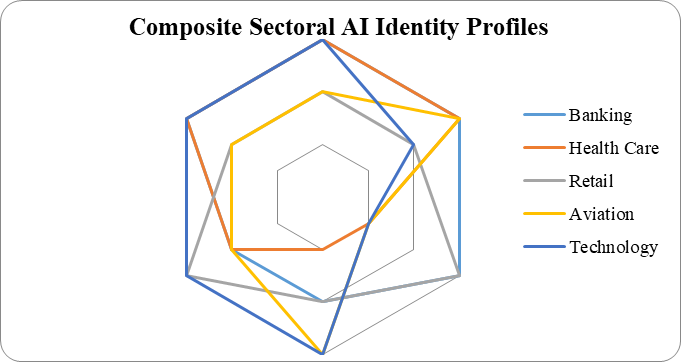
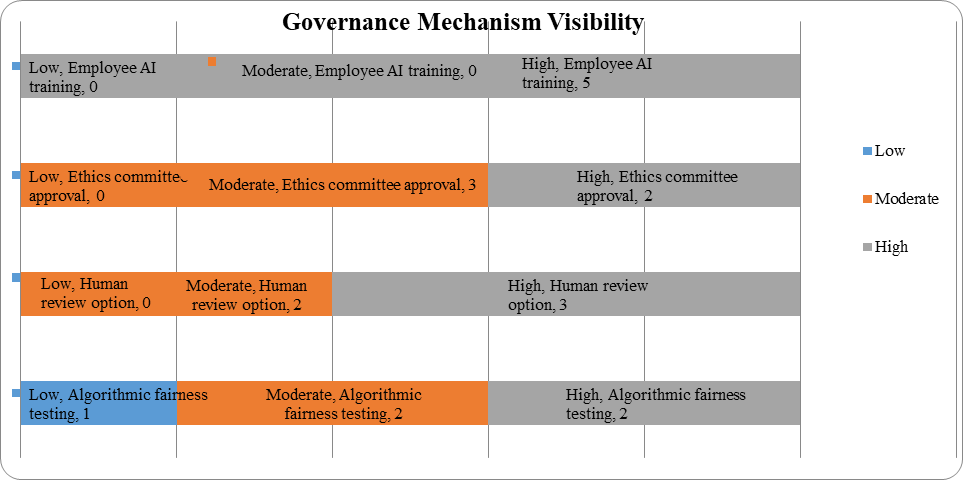
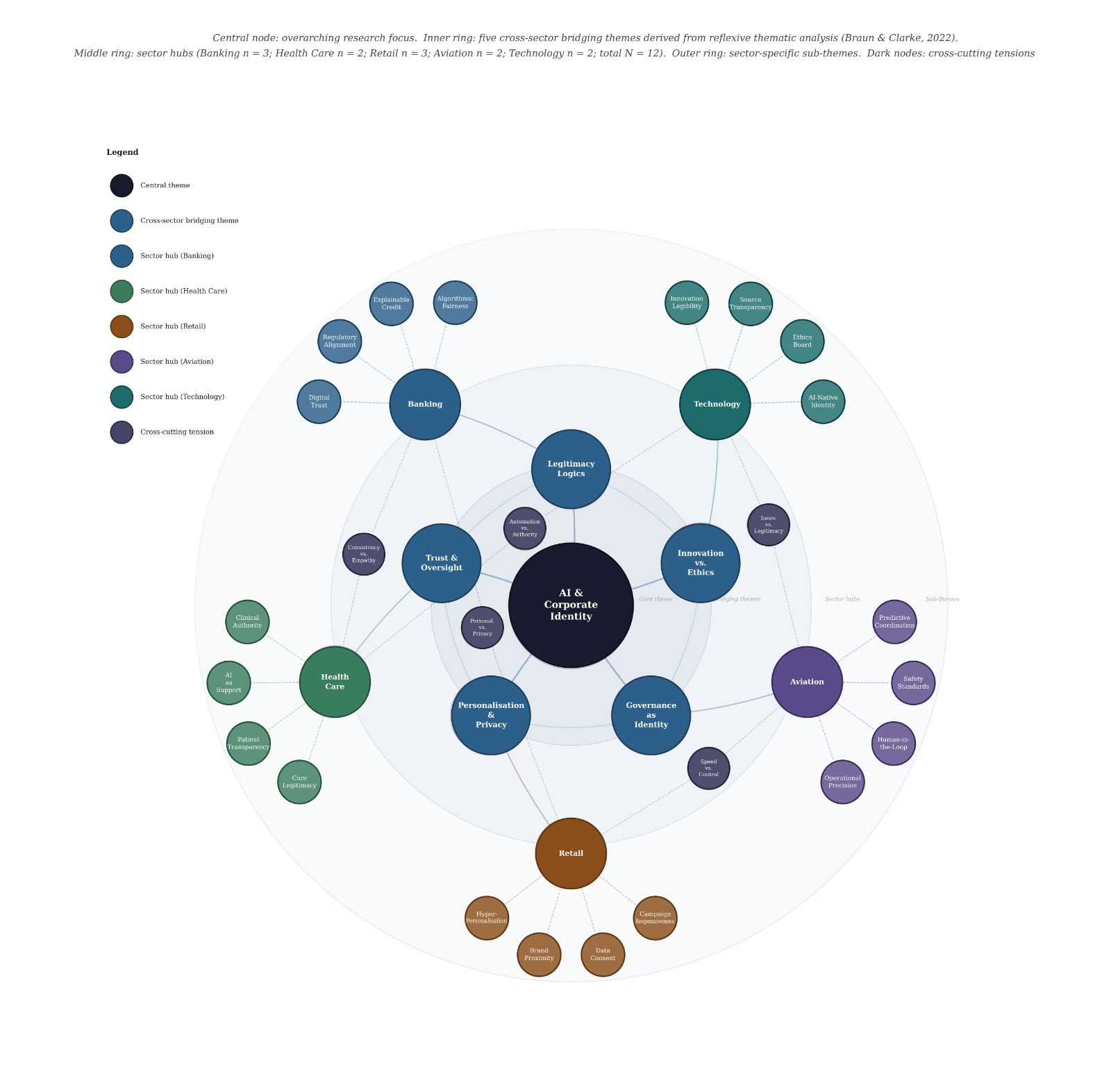
Figure 1 presents sector-specific thematic emphasis (Panel A), cross-sector analytic patterns (Panel B), and composite sectoral AI identity profiles (Panel C), showing how sectors prioritize AI-related identity dimensions. Figure 2 highlights higher-order analytical aspects: tension salience (Panel D), governance visibility (Panel E), and future differentiation axes (Panel F), illustrating AI integration as a negotiation of balancing logics, institutional controls, and strategic positioning. Figure 3 offers a thematic map linking main themes, tensions, and sectoral patterns into an overall structure.
|
|
|
Figure 1. Composite Sectoral AI Identity Profiles |
|
|
|
Figure 2. Governance Mechanism Visibility |
Figure 3. Thematic Map: AI Integration and Corporate Identity
Salience ratings were assigned at the participant level and aggregated by sector (Banking n=3, Health Care n=2, Retail n=3, Aviation n=2, Technology n=2). Values were classified as High (≥2.5), Moderate (1.5–2.4), or Low (≤1.4) for display. All visuals were produced in Python (Matplotlib) to ensure consistency and reproducibility.
The figures are not intended as quantitative measurements but as interpretive visual summaries. The salience categories represent analyst-assigned ordinal distinctions derived from the thematic analysis and are used to indicate relative prominence across sectors rather than frequency or statistical magnitude. This approach is consistent with the use of summary matrices in qualitative comparative analysis (Miles et al., 2014) and is included to enhance analytic transparency.
Ethical Considerations
Ethical approval for this study was granted by [INSERT ETHICS COMMITTEE NAME AND REFERENCE NUMBER, e.g., the Institutional Review Board of [UNIVERSITY], approval no. [XX/XXXX/XX]]. All procedures were conducted in accordance with the ethical principles of the Declaration of Helsinki and the applicable data protection legislation. Participant anonymity was maintained throughout the research process: no names, organizational affiliations, or other identifying details are reported in the manuscript. Audio recordings will be retained for [INSERT RETENTION PERIOD, e.g., five years] following publication and will subsequently be securely destroyed in accordance with institutional data management policy. Participation was voluntary and unpaid; participants were informed that withdrawal was possible at any stage without consequence.
Reflexivity
In keeping with the reflexive orientation of Braun and Clarke’s (2006, 2021) approach, we acknowledge that thematic analysis is not a neutral extraction of pre-existing meaning but an active construction shaped by the analyst’s theoretical commitments, disciplinary positioning, and interpretive choices. The lead researcher’s background in corporate communication and organizational identity research informed the conceptual framing of the study and the design of the interview guide. Where possible, these preconceptions were documented in reflective memos maintained throughout the analytical process. The use of independent coding and member-checking, described above, was employed not to neutralize subjectivity but to render the analytical process more transparent and to introduce alternative interpretive perspectives into the analysis.
Results and Discussion
Five sectors. Fifteen questions. One finding that cuts against the grain of the prevailing modernization narrative: AI did not enter corporate identity through a single door. Drawing on semi-structured interviews conducted across banking, health care, retail, aviation, and technology, the analysis revealed that AI became part of institutional identity only when it fit the legitimacy logic already operative within each sector. What varied was not whether AI was visible, but what made it acceptable, and that distinction, as the data show, is consequential.
Sector-Specific Identity logics of AI Integration
The cross-sector analysis shows that AI’s integration into corporate identity is less about its presence and more about the conditions under which it is admitted. Across sectors, AI had to earn legitimacy, but the criteria differed.
In banking, AI was framed as an extension of institutional values—reliability, accountability, and trust. Explainability and auditability were prerequisites, and innovation was recognized only when fully auditable. AI-supported decisions included options for human review to maintain regulatory and ethical commitments.
In health care, AI was strictly subordinate to professional authority. It served as a decision-support tool, not a decision-maker, ensuring human judgment and patient trust remained central. Transparency about AI’s role in processes was essential.
In retail, AI’s legitimacy depended on customer relevance. Personalization enhanced identity only if it avoided intrusion. Brands actively managed the balance between responsiveness and privacy, implementing limits on algorithmic content and frequency.
In aviation, AI legitimacy was grounded in operational precision and reliability. Oversight was essential but focused on safety and failure prevention rather than relational trust. Human supervision ensured critical decisions remained under control, especially in crises.
In technology, AI was constitutive of the organization itself. Yet legitimacy required more than technical capability: explainability, ethical design, and data accountability were central to trust and sustainable competitive advantage. Even in a sector highly saturated with AI, identity claims depended on aligning innovation with ethical and transparent practices.
Overall, the study highlights that AI integration into corporate identity is sector-specific, guided by legitimacy logics rather than uniform capability narratives. Each sector negotiated boundaries reflecting its priorities—regulatory compliance, professional authority, customer trust, operational reliability, or ethical innovation—showing that AI becomes identity-relevant only when aligned with the values and expectations embedded in the institutional environment.
AI Amplified Some Identity Dimensions More Readily than others.
One of the most analytically productive findings emerged not from what participants said AI could do, but from what they consistently said it could not. Across all five sectors, AI was readily associated with consistency, speed, predictive coordination, and personalization. These are scalable capacities that automated systems excel at precisely because they operate at scale, without fatigue or the variance introduced by human interaction. But a different set of dimensions, empathy, affective nuance, and context-sensitive tone surfaced repeatedly as resistant to encoding. (Figure 1) Participants did not present this as a temporary limitation awaiting a technical fix. They presented it as a structural feature of what automated systems are. (Table 3) The health care general manager gave the clearest formulation: “Empati zor aktırılıyor. Kriz anında bağlamsal yorum eksik kalabiliyor” [Empathy is hard to transfer. Contextual interpretation can fall short in crisis moments (K2, Health care). A banking participant described the same limit from a different angle: “Chatbot müşteriye hızlı cevap veriyor ama ’sizi anladım’ hissini veremiyor” [The chatbot gives the customer a fast answer, but it cannot give the feeling of being understood] (K11, Banking).
The implication for identity theory is not trivial. AI did not modernize corporate identity uniformly; it redistributed which aspects of identity became easier to sustain and which became harder to represent. Functional, anticipatory, and standardized dimensions gained visibility and scale. Relational and emotionally calibrated dimensions became more fragile not because organizations stopped valuing them, but because the tools available for expressing them at scale were less adequate. This asymmetry was sharpest in banking and health care, where trust was the primary legitimacy resource yet could not be reduced to reliable outputs. Retail managed some integration of tone into AI-supported communication; technology treated it as already a solved problem, largely because AI had been woven into the organizational fabric long enough that its effective limits had become design constraints rather than open questions.
Questions 11–15 Revealed Balancing Logics Rather than Isolated Themes
The later sections of the interview guide, covering value reflection, identity tensions, ethics, governance, and future orientation, were analytically the richest because they moved participants away from descriptive inventories of AI applications and into the territory of what those applications cost them. What emerged was not a list of themes but a set of balancing logics: recurring tensions that participants across sectors were managing rather than resolving. The first and most pervasive tension was between consistency and empathy. Automated systems offered something genuinely valuable: stability, scale, predictability. What they could not offer was the kind of responsiveness that feels human, the ability to read a situation, adjust the register, and communicate care rather than process. Participants did not frame this as a software problem. They framed it as a boundary condition of identity work in sectors where being trusted means being felt.
A second tension ran through nearly every sector: speed against control. AI was universally associated with faster decisions, faster responses, and faster pattern recognition. But the material made clear that speed alone did not produce legitimacy. Participants consistently paired acceleration with the language of restraint: approval procedures, review layers, audit mechanisms, and rights to human intervention. This was not resistance to AI; it was a theory of how AI earns the right to act. What the data revealed was a vision of managed automation, a negotiated rather than wholesale transition in which the presence of oversight mechanisms was itself a legitimacy signal. Governance was not described as a brake on AI capability; it was described as the condition under which AI capability becomes institutionally credible (Tables 2 and 3).
Table 2. Core Identity Tensions in AI-Enabled Corporate Transformation
|
Tension axis |
Pattern in the corpus |
|
Consistency vs. empathy |
Automated systems supported stable and scalable communication, but empathy, emotional nuance, and contextual sensitivity were harder to reproduce digitally. |
|
Speed vs. control |
AI accelerated operations and responsiveness, yet participants emphasized review, approval, and intervention mechanisms. |
|
Personalization vs. privacy |
Tailored engagement enhanced relevance, but also raised concerns about intrusive targeting, consent, and acceptable data use. |
|
Innovation vs. legitimacy |
Technical advancement was valued, but participants repeatedly tied durable differentiation to explainability, ethics, and trust. |
|
Automation vs. professional authority |
Especially in health care and aviation, AI was represented as supportive rather than fully autonomous. |
Table 3. Sector-Specific Thematic Emphasis in Human-Centered AI Integration
|
Metric |
Banking |
Health Care |
Retail |
Aviation |
Technology |
|
Explainability & Ethics |
High (3.0) |
High (3.0) |
High (3.0) |
High (3.0) |
High (3.0) |
|
Innovation Capacity |
Moderate (2.0) |
Moderate (2.0) |
Moderate (2.0) |
Moderate (2.0) |
Moderate (2.0) |
|
Operational Speed |
Moderate (2.0) |
Moderate (2.0) |
Moderate (2.0) |
Moderate (2.0) |
Moderate (2.0) |
|
Personalisation |
High (3.0) |
High (3.0) |
High (3.0) |
High (3.0) |
High (3.0) |
|
Human Oversight |
High (2.7) |
High (2.7) |
High (2.7) |
High (2.7) |
High (2.7) |
|
Trust / Regulatory Sensitivity |
High (3.0) |
High (3.0) |
High (3.0) |
High (3.0) |
High (3.0) |
The tension between personalization and privacy was most sharply articulated in banking and retail, but its implications extended across the corpus. Personalization was consistently described as an identity asset, a way of making institutional communication feel less institutional. But the same capacities that enabled personalization also enabled surveillance, and participants were alert to the distinction. What the data revealed was that personalization does not legitimize itself. It becomes persuasive only when it is bounded — when users can see where the data ends and where their consent begins. This gives the comparative analysis a sharper edge: sectors were not differentiated by how much they valued personalization, but by how explicitly they narrated its limits. That narration was itself an identity act. (Table 4)
Table 4. Higher-Order Tension Salience by Sector
|
Governance Indicator |
Banking |
Health Care |
Retail |
Aviation |
Technology |
|
Fairness Testing |
High |
High |
Moderate |
Moderate |
Low |
|
Employee AI Training |
Moderate |
Moderate |
High |
Moderate |
High |
|
Human Review Option |
High |
High |
Moderate |
High |
Moderate |
Perhaps the most analytically consequential tension was the one between innovation and legitimacy. Across all sectors, participants described AI-related capabilities as central to future differentiation—the basis on which competitive advantage would be built or lost. Yet almost none of them described technical advancement as sufficient on its own. The future-oriented responses converged on a more demanding criterion: that differentiation would depend on the ability to demonstrate not only what AI could do, but how it was governed, explained, and bounded. This reframes the competitive landscape considerably. It suggests that what distinguishes institutions in the coming period will not be access to AI capabilities — those are converging — but the legibility of the values embedded in their use of those capabilities. The material, therefore, points toward a legitimacy-centered account of AI differentiation rather than a purely technical one. (Figure 3) The aviation operations manager gave a precise formulation: “Farklılaşma yalnızca teknolojik altyapı ile değil, uluslararası güven standartlarına uyum ile sağlanacaktır” [Differentiation will be achieved not only through technological infrastructure, but through compliance with international trust standards] (K4, Aviation). The health care participant pointed to the same logic from within a different sectoral frame: “Sağlıkta farklılaşmanın ana unsuru teknolojik hız değil, güven ve etik hassasiyet olacaktır” [The main factor of differentiation in health care will not be technological speed, but trust and ethical sensitivity] (K2, Health care).
Governance Appeared as an Identity Issue, Not Only an Operational Issue.
What made the governance findings particularly striking was not their content but their register. Governance did not appear in the data as a compliance obligation — something imposed from outside and managed for its effects. It appeared as a claim about who the institution was. In banking, model review procedures and rights to human appeal were discussed in the same breath as trustworthiness (Figure 2). In aviation, safety standards and anonymization protocols were connected to reliability as an organizational value. In technology, algorithm audits, version control, and the existence of an AI Ethics Board were presented as signals of institutional character, not merely internal controls. This pattern suggests that the grammar of governance had shifted: where once it might have been described as a constraint on identity, here it functioned as a component of it (Table 2). The banking director made this explicit: “Model Risk Komitesi tüm AI projelerini onay almadan devreye alamaz bu hem etik hem de kurumsal güvenilirlik açısından zorunlu görülür” [The Model Risk Committee must approve all AI projects before deployment this is seen as necessary for both ethics and institutional credibility] (K1, Banking). The technology CEO described a parallel structure: “Şirket içinde bağımsız bir AI Ethics Board bulunmaktadır ve ürün güncellemeleri bu kuruldan geçmeden yayınlanmaz” [The company has an independent AI Ethics Board, and product updates cannot be released without passing through this board] (K5, Technology). A retail participant, notably from a sector less expected to foreground governance, articulated the same logic: “Dijital Etik Sorumlusu rolü oluşturulmuş olup AI projeleri bu birim tarafından denetlenmektedir” [A Digital Ethics Officer role has been established, and this unit audits AI projects] (K12, Retail).
Overall Pattern of the Findings
Taken together, the findings resist any account of AI integration as a single movement toward digital modernity. What the data describe instead is a set of parallel but distinct processes, each shaped by the legitimacy logic already in place within a given sector. Banking and health care anchored AI in trust and oversight; retail in proximity and relevance; aviation in precision and disciplined performance; technology in innovation and, crucially, in the ethical design structures that make innovation legible. The central finding is therefore not that AI transformed corporate identity, but that corporate identity transformed the terms on which AI could enter. The consequential question was never whether AI was visible; it was, but what made it identity-compatible sector by sector, institution by institution.
The findings suggest that AI becomes part of corporate identity not through a universal modernization process, but through sector-specific legitimacy conditions. Recent research increasingly frames AI implementation as a socio-organizational issue shaped by accountability, transparency, oversight, and institutional fit rather than technical capability alone (Lahusen et al., 2024; Bartsch et al., 2025). Accordingly, differences across sectors reflect distinct value systems through which AI becomes identity-compatible. Trust, for example, depends on governance structures, accountability, and human–AI coordination rather than the technology itself (de Almeida & dos Santos Júnior, 2025).
The study also shows that AI reinforces some identity dimensions more strongly than others. Participants associated AI mainly with speed, consistency, coordination, and scalable responsiveness, while empathy, contextual sensitivity, and emotionally nuanced communication remained more difficult to achieve. This aligns with evidence that AI-driven personalization can improve trust and usefulness without necessarily increasing engagement, especially when concerns about privacy, fairness, and ethics persist (Markou et al., 2025; Teepapal, 2025). Similarly, transparency alone does not automatically generate trust, as disclosure may strengthen or complicate stakeholder judgments depending on context (Grigsby et al., 2025; Schilke & Reimann, 2025). AI therefore appears more effective in strengthening the operational clarity of identity than its relational or symbolic depth.
Sectoral differences further highlight that AI legitimacy depends on different institutional priorities. Banking emphasized explainability, auditability, and reviewability; health care stressed maintaining AI under professional judgment and patient trust; retail focused on personalization while limiting intrusive data use; aviation associated AI with safety, reliability, and operational precision; and technology linked AI to innovation combined with ethical and explainable design. These findings suggest that AI becomes identity-relevant through distinct value hierarchies rather than a single modernization pathway (de Almeida & dos Santos Júnior, 2025; Starke et al., 2025; Teepapal, 2025; Bailo et al., 2026; Yiu et al., 2026).
Health care and aviation demonstrated particularly important differences in the meaning of human oversight. In health care, oversight protected clinical judgment and patient trust, whereas in aviation it supported safety, certification, and reliability. This suggests that “human in the loop” varies according to the type of legitimacy each sector seeks to preserve. Retail added another dimension by showing that personalization can simultaneously strengthen customer relevance and create concerns about intrusion, making the definition of acceptable personalization itself part of corporate identity work.
The findings also indicate that sustainable competitive differentiation depends less on access to AI capabilities than on how understandable, trustworthy, and governable those capabilities appear to stakeholders. Ethical design, transparency, human review, and value consistency therefore emerged as strategic identity resources rather than secondary concerns. AI-related identity work becomes persuasive when it reflects the legitimacy expectations already embedded within a sector’s institutional environment.
Several limitations should be noted. The study is qualitative, cross-sectoral, and based on a relatively small sample of senior participants, emphasizing interpretive depth rather than statistical generalization. It primarily reflects managerial perspectives and relies on narrated accounts rather than direct observation of AI practices. In addition, the visual matrices and salience classifications are interpretive tools rather than quantitative measures. Finally, because AI governance and stakeholder expectations continue to evolve, AI-related identity narratives are likely to change over time. Future research could expand the analysis through longitudinal studies, stakeholder-focused perspectives, and deeper sector-specific investigations.
Conclusion
The findings show that AI did not enter corporate identity through a uniform logic of digital modernization. Rather, AI became identity-relevant when it aligned with the dominant legitimacy logic of each sector. Banking and health care emphasized trust, explainability, and human oversight; retail foregrounded personalization and customer relevance; aviation highlighted operational precision and managed automation; and technology linked AI to innovation while still stressing ethical design and governance. Across sectors, AI appeared to strengthen speed, consistency, predictive coordination, and scalable responsiveness more readily than empathy, contextual sensitivity, and affective nuance. The analysis also identified recurring tensions between consistency and empathy, speed and control, personalization and privacy, innovation and legitimacy, and automation and professional authority.
Declaration on the Use of Artificial Intelligence
Artificial intelligence tools were used in a limited and supportive capacity during the preparation of this manuscript. Specifically, the ChatGPT (GPT-5.3 reasoning model) was used for language editing, grammar correction, and stylistic refinement. The authors take full responsibility for the content of this manuscript, including the accuracy of the data, the integrity of the analysis, and the interpretation of the findings. No AI tools were used for data collection, data analysis, or the generation of scientific conclusions.
Acknowledgments: The authors would like to thank all participants who contributed their time and insights to this study.
Conflict of Interest: None
Financial Support: None
Ethics Statement: None
Afroogh, S., Akbari, A., Malone, E., Kargar, M., & Alambeigi, H. (2024). Trust in AI: Progress, challenges, and future directions. Humanities and Social Sciences Communications, 11(1), 1568. doi:10.1057/s41599-024-04044-8
Ameen, N., Tarhini, A., Reppel, A., & Anand, A. (2021). Customer experiences in the age of artificial intelligence. Computers in Human Behavior, 114, 106548. doi:10.1016/j.chb.2020.106548
Bailo, P., Nittari, G., Pesel, G., Basello, E., Spasari, T., & Ricci, G. (2026). Governing Healthcare AI in the Real World: How Fairness, Transparency, and Human Oversight Can Coexist: A Narrative Review. Sci, 8(2). doi:10.3390/sci8020036
Balmer, J. M. T. (2017). The corporate identity, total corporate communications, stakeholders’ attributed identities, identifications, and behaviors continuum. European Journal of Marketing, 51(9/10), 1472–1502. doi:10.1108/EJM-07-2017-0448
Balmer, J. M. T., & Podnar, K. (2021). Corporate brand orientation: Identity, internal images, and corporate identification matters. Journal of Business Research, 134, 729–737. doi:10.1016/j.jbusres.2021.06.016
Bartsch, S. C., Nguyen, L. H., Schmidt, J.-H., Du, G., Adam, M., Benlian, A., & Sunyaev, A. (2025). The Present and Future of Accountability for AI Systems: A Bibliometric Analysis. Information Systems Frontiers, 27(6), 2463–2484. doi:10.1007/s10796-025-10636-9
Batool, A., Zowghi, D., & Bano, M. (2025). AI governance: A systematic literature review. AI and Ethics, 5(3), 3265–3279. doi:10.1007/s43681-024-00653-w
Bratt, A., & Naimi-Akbar, A. (2023). A comparative study of ethical issues in the Egyptian clinical research law. Asian Journal of Ethics, Health and Medicine, 3, 66–80. doi:10.51847/mjnPnkn27U
Braun, V., & Clarke, V. (2006). Using thematic analysis in psychology. Qualitative Research in Psychology, 3(2), 77–101. doi:10.1191/1478088706qp063oa
Braun, V., & Clarke, V. (2019). Reflecting on reflexive thematic analysis. Qualitative Research in Sport, Exercise and Health, 11(4), 589–597. doi:10.1080/2159676X.2019.1628806
Braun, V., & Clarke, V. (2021). Thematic analysis: A practical guide.
Bryman, A. (2016). Social research methods. Oxford University Press.
Cakmak, C., Cinar, F., Çapar, H., & Cakmak, M. A. (2024). The connection between cancer screening, awareness, and perceptions: Insights from the American population. International Journal of Social Psychology Aspects of Healthcare, 4, 32–41. doi:10.51847/CCd71JaG8g
Chen, A. M. H., & Chen, Y. (2023). Pharmacognostic and phytochemical comparison of Moringa oleifera and Moringa concanensis. Special Journal of Pharmacognosy, Phytochemistry and Biotechnology, 3, 1–9. doi:10.51847/iVjkOGlcDE
Chen, Y., & Prentice, C. (2025). Integrating Artificial Intelligence and Customer Experience. Australasian Marketing Journal, 33(2), 141–153. doi:10.1177/14413582241252904
Çınaroğlu, M., Ahlatcıoğlu, E. N., Prins, J., & Nan, M. (2023). Psychological challenges in cancer patients and the impact of cognitive behavioral therapy. International Journal of Social Psychology Aspects of Healthcare, 3, 21–33. doi:10.51847/ZDLdztUSsw
Cissé, C., Konaré, M. A., Samaké, M., & Togola, I. (2024). Exploring the anti-inflammatory potential of Sericanthe chevalieri and Ceiba pentandra as natural antitussives for children. Special Journal of Pharmacognosy, Phytochemistry and Biotechnology, 4, 49–58. doi:10.51847/0OVczhRtw1
Creswell, J. W., & Poth, C. N. (2016). Qualitative inquiry and research design: Choosing among five approaches. Sage Publications.
Csep, A. N., Voiţă-Mekereş, F., Tudoran, C., & Manole, F. (2024). Understanding and managing polypharmacy in the aging population. Annals of Pharm Practice and Pharmacotherapy, 4, 17–23. doi:10.51847/VdKr0egSln
Czakon, W., Mania, K., Jedynak, M., Kuźniarska, A., Choiński, M., & Dabić, M. (2024). Who are we? Analyzing the digital identities of organizations through the lens of micro-interactions on social media. Technological Forecasting and Social Change, 198, 123012. doi:10.1016/j.techfore.2023.123012
Dahlin, E. (2025). Trust in AI. AI & SOCIETY, 40(8), 6089–6095. doi:10.1007/s00146-025-02429-0
de Almeida, P. G. R., & dos Santos Júnior, C. D. (2025). Artificial intelligence governance: Understanding how public organizations implement it. Government Information Quarterly, 42(1), 102003. doi:10.1016/j.giq.2024.102003
Dong, Y. (2025). Implementation of artificial intelligence for brand equity. Cogent Business & Management, 12(1), 2471538. doi:10.1080/23311975.2025.2471538
Flick, U. (2022). An introduction to qualitative research.
Foroudi, P., Turan, C. P., Melewar, T., Dennis, C., & Tzempelikos, N. (2024). Corporate identity management: A study of employees’ perceptions in the context of the retail, hospitality, and tourism sectors. International Journal of Hospitality Management, 122, 103876. doi:10.1016/j.ijhm.2024.103876
Grigsby, J. L., Michelsen, M., & Zamudio, C. (2025). Service ads in the era of generative AI: Disclosures, trust, and intangibility. Journal of Retailing and Consumer Services, 84, 104231. doi:10.1016/j.jretconser.2025.104231
Gupta, S., Melewar, T. C., & Foroudi, P. (2025). AI strategy for global brand identity. Industrial Marketing Management, 131, A1–A7. doi:10.1016/j.indmarman.2025.10.007
Guzek, K., Stelmach, A., Rożnowska, A., Najbar, I., Cichocki, Ł., & Sadakierska-Chudy, A. (2023). A preliminary investigation of genetic variants linked to aripiprazole-induced adverse effects. Annals of Pharm Practice and Pharmacotherapy, 3, 40–47. doi:10.51847/ZT28xcs95J
Hashem, W., Mokhtar, M., Rahman, A. A., & Rashad, A. (2024). Adult acute lymphoblastic leukemia: Insights from six years of clinical practice in an Egyptian tertiary care center. Asian Journal of Current Research in Clinical Cancer, 4(2), 51–61. doi:10.51847/fFirKGgI3X
He, H., & Brown, A. D. (2013). Organizational Identity and Organizational Identification: A Review of the Literature and Suggestions for Future Research. Group & Organization Management, 38(1), 3–35. doi:10.1177/1059601112473815
Hein-Pensel, F. (2026). Organizational identity meets digital transformation: Understanding the interplay between transformation and identity in Industry 5.0. Journal of Organizational Change Management, 39(8), 1–21. doi:10.1108/JOCM-04-2025-0352
Hue, T. T., & Hung, T. H. (2025). Impact of artificial intelligence on branding: A bibliometric review and future research directions. Humanities and Social Sciences Communications, 12(1), 209. doi:10.1057/s41599-025-04488-6
Kariri, H. D. H., Radwan, O. A., Somaili, H. E., Mansour, M. E. I., Mathkoor, S. A., & Gohal, K. M. M. (2024). The role of psychological capital in enhancing empowerment among female leadership. Annals of Organ Culture, Leadership and External Engagement Journal, 5, 17–27. doi:10.51847/w41TjwMAzM
King, N., Brooks, J., & Horrocks, C. (2018). Interviews in qualitative research. https://www.torrossa.com/gs/resourceProxy?an=5019272&publisher=FZ7200
Lahusen, C., Maggetti, M., & Slavkovik, M. (2024). Trust, trustworthiness, and AI governance. Scientific Reports, 14(1), 20752. doi:10.1038/s41598-024-71761-0
Leadbeatter, D., & Tjaya, K. C. (2024). Human rights and bioethical principles in correctional settings: A systematic review of the evidence. Asian Journal of Ethics, Health and Medicine, 4, 97–106. doi:10.51847/wSNBedLrGt
Manfredini, M., Poli, P. P., Giboli, L., Beretta, M., Maiorana, C., & Pellegrini, M. (2024). Determinants of dental implant prognosis: A systematic review of key influencing factors. Journal of Current Research in Oral Surgery, 4, 41–49. doi:10.51847/Gv4h1XyPfr
Markou, V., Serdaris, P., Antoniadis, I., & Spinthiropoulos, K. (2025). Personalization, Trust, and Identity in AI-Based Marketing: An Empirical Study of Consumer Acceptance in Greece. Administrative Sciences, 15(11). doi:10.3390/admsci15110440
Miles, M. B., Huberman, A. M., & Saldana, J. (2014). Qualitative data analysis. sage.
Mitchell, T. (2025). Trust and Transparency in Artificial Intelligence. Philosophy & Technology, 38(3), 87. doi:10.1007/s13347-025-00916-2
Muthanandam, S., Muthu, J., Babu, B. V., Rajaram, S., & Kengadharan, S. (2024). Raising awareness of oral precancer and cancer among Indian long-distance heavy vehicle drivers: A neglected group. International Journal of Social Psychology Aspects of Healthcare, 4, 20–25. doi:10.51847/2JNlaeP6n5
Nyamagoud, S. B., Swamy, A. H. V., Chacko, A., & James, J. (2024). A case report on actinomycetoma of the left foot: Highlighting a neglected tropical disease and the consequences of poor medication adherence. Interdisciplinary Research in Medical Science Special, 4(2), 41–47. doi:10.51847/UcEjBW4qBs
Ozturkcan, S., & Bozdağ, A. A. (2025). Responsible AI in Marketing: AI Booing and AI Washing Cycle of AI Mistrust. International Journal of Market Research, 67(6), 696–722. doi:10.1177/14707853251379285
Patton, M. Q. (2015). Qualitative research & evaluation methods: Integrating theory and practice. (No Title).
Petronis, Z., Golubevas, R., Rokicki, J. P., Guzeviciene, V., Sakavicius, D., & Lukosiunas, A. (2025). A systematic review and meta-analysis on trigeminal neuralgia linked to neurovascular compression using MRI analysis. Journal of Current Research in Oral Surgery, 5, 17–24. doi:10.51847/sptZWIrWeo
Ribeiro, A., Rivero, A. J. L., & Abrantes, J. L. (2025). The impact of artificial intelligence on consumer behavior towards brands: A systematic review. Electronic Commerce Research. doi:10.1007/s10660-025-10063-7
Ritchie, J., Ormston, R., McNaughton Nicholls, C., & Lewis, J. (2013). Qualitative research practice: A guide for social science students and researchers.
Salikhova, L. R., Khantueva, K. K., Magomedkerimova, N. N., Arganov, F. I., Tambieva, T. S., & Brodskaya, T. A. (2023). Evaluating the likelihood of hypoxia in pregnant women through analysis of erythrocyte membrane permeability. Interdisciplinary Research in Medical Science Special, 3(1), 20–25. doi:10.51847/nsfOJO4IDe
Schilke, O., & Reimann, M. (2025). The transparency dilemma: How AI disclosure erodes trust. Organizational Behavior and Human Decision Processes, 188, 104405. doi:10.1016/j.obhdp.2025.104405
Shams, R., Chatterjee, S., & Chaudhuri, R. (2024). Developing brand identity and sales strategy in the digital era: Moderating role of consumer belief in brand. Journal of Business Research, 179, 114689. doi:10.1016/j.jbusres.2024.114689
Singh, D., Piplani, M., Kharkwal, H., Murugesan, S., Singh, Y., Aggarwal, A., & Chander, S. (2023). Comprehensive Review on the Anticancer Potential of Thiazolidin-4-One Derivatives. Asian Journal of Current Research in Clinical Cancer, 3(1), 46-62. doi:10.51847/MpJ9fZKGZT
Starke, G., Gille, F., Termine, A., Aquino, Y. S. J., Chavarriaga, R., Ferrario, A., Hastings, J., Jongsma, K., Kellmeyer, P., Kulynych, B., et al. (2025). Finding Consensus on Trust in AI in Health Care: Recommendations From a Panel of International Experts. Journal of Medical Internet Research, 27(1), e56306. doi:10.2196/56306
Tam, L. T., An, H. T. T., Linh, T. K., Nhung, L. T. H., Ha, T. N. V., Huy, P. Q., & Luc, P. T. (2023). The Impact of COVID-19 on Value Co-Creation Activities: A Study of Economics Students in Vietnam. Annals of Organizational Culture, Leadership and External Engagement Journal, 4, 25-34. doi:10.51847/QeaHrAoLoL
Teepapal, T. (2025). AI-driven personalization: Unraveling consumer perceptions in social media engagement. Computers in Human Behavior, 165, 108549. doi:10.1016/j.chb.2024.108549
Thomas, J., & Harden, A. (2008). Methods for the thematic synthesis of qualitative research in systematic reviews. BMC Medical Research Methodology, 8(1), 45. doi:10.1186/1471-2288-8-45
Turki, H. (2025). AI-powered personalization in e-commerce: Governance, consumer behavior, and exploratory insights from big data analytics. Technology in Society, 83, 103033. doi:10.1016/j.techsoc.2025.103033
Verma, S., Sharma, R., Deb, S., & Maitra, D. (2021). Artificial intelligence in marketing: Systematic review and future research direction. International Journal of Information Management Data Insights, 1(1), 100002. doi:10.1016/j.jjimei.2020.100002
Yiu, C. Y., Li, W.-C., Ng, K. K. H., Chi, C.-F., & Schiefele, J. (2026). Enhancing aviation safety with artificial intelligence: A systematic literature review on recent advances, challenges, and future perspectives. Advanced Engineering Informatics, 71, 104378. doi:10.1016/j.aei.2026.104378