
This study examines campus journalism practices, highlighting challenges and identifying growth opportunities. Focusing on the implementation of the Campus Journalism Act of 1991 in Mountain Province, Philippines, it examines educators’ perspectives and challenges, revealing varied awareness and resource limitations. Despite obstacles, campus journalism helps students develop essential skills in journalism, critical thinking, and civic engagement. The research employed a descriptive-survey design, collecting data through online surveys with 32 respondents, focus group discussions involving 28 teachers and four principals, and interviews with School Paper Advisers and members of the Technical Working Group. Additional insights were gained through document analysis of school requests, providing a comprehensive understanding of campus journalism implementation across school levels. The study underscores the need for enhanced training, stronger support systems, and collaboration among schools and media professionals. Extension programs through higher education institutions (HEIs), such as Mountain Province State University, are vital for curriculum enhancement and skills development, ultimately empowering student journalists and contributing to community transformation.
Introduction
In today’s interconnected and information-driven world, the role of journalism, particularly at the grassroots level, has become more crucial than ever. Student journalism, as an emerging platform within educational institutions globally, not only nurtures future media professionals but also plays a pivotal role in fostering democratic values, critical thinking, and youth empowerment. Across various countries, student publications have proven to be powerful tools for amplifying the voices of the youth, encouraging civic participation, and holding institutions accountable. As global challenges increasingly demand informed and engaged citizens, strengthening campus journalism becomes essential in building resilient, participatory societies rooted in transparency, dialogue, and ethical communication.
In the Philippines, press freedom is enshrined as a fundamental right, and this extends even to student journalists through Republic Act 7079, also known as the Campus Journalism Act of 1991 (CJA) (Cubillas & Cubillas, 2021). The law defines campus journalism as a multifaceted activity that includes news gathering, editorial and feature writing, photography, cartooning, and headline creation. But beyond its technical dimensions, campus journalism plays a deeper role: it serves as a dynamic training ground that sharpens not only students’ journalistic competence but also their interpersonal, ethical, and civic sensibilities.
The CJA’s core objective is to foster the growth of campus journalism as a tool for cultivating moral character, critical and creative thinking, personal discipline, and ethical values among Filipino youth (Dadayan, 2021; Espado, 2022). In pursuit of this, it mandates the inclusion of campus journalism in public elementary and secondary schools, particularly those that collect journalism fees.
Campus journalism, therefore, emerges as a key component of holistic education. It provides learners with an authentic platform to develop their communication skills, express themselves, and actively participate in school and societal affairs (Geanhs, 2024). Campus journalism develops critical thinking, communication skills, ethical awareness, responsibility, and engagement among students, offering practical, real-world journalism experience while fostering moral character and analytical reasoning (Graybeal, G. M., & Sindik, D., 2012; Dasalla & Protacio, 2025).
The student publications serve as ethical training grounds where students learn the value of honesty, fairness, and accountability in media, equipping them to recognize and navigate complex ethical issues in journalism (Graybeal, G., & Sindik, A., 2012). Also, institutions that support school papers demonstrate their commitment to literacy and active student participation, thereby enhancing school culture through these tangible markers of engagement.
Despite the presence of enabling legislation, the implementation of the CJA continues to face persistent challenges. Issues such as the lack of clear editorial policies, the qualifications and workload of school paper advisers, inadequate funding, and limited awareness of the law itself have been reported in different regions. For example, in the Division of Tandag City, such problems were classified as “serious to very serious,” obstructing the full realization of the law’s intent. Similarly, a study in Butuan City identified the heavy teaching load of advisers and insufficient program support as critical barriers to effective campus journalism practices (Cervantes, 2020; Natividad & Gapasin, 2021; Divino et al., 2025).
Amidst these challenges, higher education institutions (HEIs) play a crucial role. As mandated by their role in community development, HEIs are expected to extend their expertise through extension programs that promote skills development and lifelong learning—efforts that align with Sustainable Development Goal 4 (SDG4): ensuring inclusive and equitable quality education for all. In this regard, Colleges of Teacher Education frequently design training programs targeting basic education, particularly to build competencies in specialized areas such as journalism.
Several successful initiatives highlight the transformative potential of HEIs in campus journalism. The “Write Here, Right Now” extension project, conducted by a state university in Laguna, enhanced the journalism skills of elementary students and led to the establishment of a school paper, which achieved notable recognition in press conferences (Chavez, 2023). Similarly, Cubillas and Cubillas (2024) proposed a Campus Journalism Implementation Teachers’ Training Model aimed at improving awareness and compliance with the CJA, emphasizing the need for structured educator support (Chavez, 2023; Cubillas & Cubillas, 2024).
In the Cordillera region, like all other state universities and colleges, the Mountain Province University (MPSU) is likewise mandated to promote community development, capacity-building, and knowledge transfer through responsive extension programs. As a key HEI in the area, the university recognizes the need to address pressing educational gaps, including the challenges faced by journalism teachers and school paper advisers in implementing the CJA. In alignment with SDG4 and its institutional commitment to lifelong learning, the university has supported capacity-building initiatives in its partner schools through its departments.
Anchored on this context, the present study aims to examine the perspectives of school paper advisers and journalism teachers on the implementation of the Campus Journalism Act in the province. By capturing their lived experiences, challenges, and support needs, this research aims to establish a foundation for the development of targeted extension programs. It posits that strengthening the capacity of campus journalism educators will not only improve the quality of student publications and journalistic training but also empower student journalists to become informed, critical, and engaged citizens. Ultimately, the findings of this study are expected to contribute to community transformation and the sustainable growth of campus journalism in the province through contextually relevant and institutionally supported initiatives.
Conceptual Framework and Research Paradigm
This study is anchored on the Campus Journalism Act of 1991 or Republic Act No. 7079, which serves as the guiding legal and theoretical foundation. Enacted to uphold press freedom and promote the development of campus journalism, the law mandates the establishment of student publications in both public and private schools and provides provisions for their autonomy, funding, and training (Congress of the Philippines, 1991).
To contextualize this framework in current school settings, the study also considers related Department of Education issuances such as DepEd Order No. 94, s. 2009 and DepEd Order No. 25, s. 2018, which outlines the operational guidelines for the National Schools Press Conference (NSPC) and other journalism-related activities in line with the CJA (Department of Education, 2009, 2018). These issuances help translate the legal mandates of the Act into actionable school-based programs.
Several scholarly works have pointed out that while the Campus Journalism Act promotes student press freedom, persistent issues remain in its implementation, including administrative interference, insufficient funding, and lack of training for student journalists and advisers (Cervantes, 2020; Natividad & Gapasin, 2021). These findings support the study’s goal of identifying gaps between the law’s intended goals and the on-ground realities in schools.
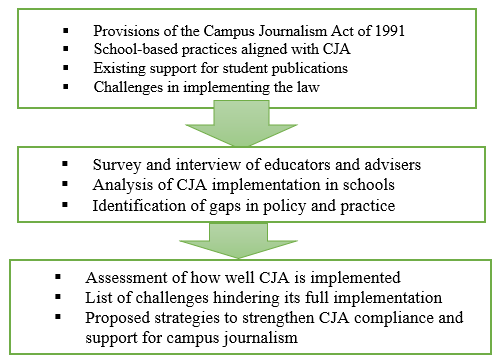
Using the Input-Process-Output (IPO) model as presented in Figure 1, the framework examines how the provisions of the Act are implemented, what challenges are encountered, and what possible strategies can be formulated to improve its fulfillment. The input includes the provisions of the law, institutional policies, and support systems. The process involves gathering and analyzing data through surveys and interviews with journalism advisers and educators. The output provides an assessment of CJA implementation, identifies barriers, and proposes recommendations to strengthen campus journalism in the province.
|
|
|
Figure 1. Paradigm of the Study |
Statement of Problems
Materials and Methods
Research Design
This study utilized a descriptive-survey research design to investigate the implementation of campus journalism in Mountain Province, focusing on its practices, challenges, and outcomes. According to Aggarwal (2008), as cited by Salaria (2012), defined, descriptive research aims to gather information for description and interpretation, including analysis, comparisons, and identification of trends. Survey research complements this by collecting data through questionnaires or interviews to describe attitudes, behaviors, or characteristics within the target population.
Population and Locale of the Study
This study was conducted in Mountain Province, focusing on the implementation of campus journalism in schools across the region. The research utilized purposive sampling to ensure that participants were directly involved in or knowledgeable about campus journalism practices. Twenty-seven (27) schools responded, including public and private (13) elementary and (14) high schools. This geographic representation underscores the study's inclusivity across diverse locales within the province.
The study engaged a total of 32 respondents through an online survey conducted from August 2024 to March 2025. These respondents were primarily School Paper Advisers (SPAs) and coaches who play critical roles in guiding student journalists. Additionally, eight focus group discussions (FGDs) were held with a total of 28 selected teachers and 4 principals from various schools. These FGDs provided valuable insights into challenges and strategies for implementing campus journalism programs. Three one-on-one interviews were conducted with SPAs and members of the Technical Working Group (TWG) of the Division Schools Press Conference (DSPC), focusing on specific issues such as special program projects and related questions about campus journalism.
To supplement these qualitative methods, document analysis was performed on records spanning the last three years. This analysis focused on frequent requests from partner schools, providing historical context for campus journalism needs and trends. The combination of surveys, FGDs, interviews, and document analysis ensured a comprehensive data collection approach that addressed both current practices and historical developments.
The purposive sampling method was integral to this study's design. By selecting participants based on their roles in campus journalism, the research ensured that the data collected was relevant and reliable. The demographic diversity of participants, including SPAs, teachers, principals, and TWG members, allowed for a better understanding of how campus journalism is implemented here. This approach not only strengthened the validity of the findings but also highlighted the unique socio-cultural dynamics influencing journalism education in the province.
Data Gathering Tools
This study employed an online survey questionnaire as the primary instrument for data collection, anchored on the provisions of the Campus Journalism Act of 1991. The questionnaire was structured into six main parts to comprehensively capture the respondents' demographic profiles, awareness of the Act, its implementation, challenges and support mechanisms, outcomes and impacts, as well as additional comments and suggestions.
The questionnaire was developed by referencing key provisions of the Campus Journalism Act of 1991 and related literature on campus journalism practices in the Philippines. It was then reviewed and modified to suit the cultural and professional context of Mountain Province, ensuring relevance to the respondents' experiences as teachers, student-journalists, school administrators, and other stakeholders. The instrument included both closed-ended questions for quantitative analysis and open-ended questions to gather qualitative insights.
To ensure reliability and validity, the questionnaire underwent a pilot test with a small group of School Paper Advisers (SPAs) from nearby schools not included in the study. Feedback from this pilot test was used to refine the questions' clarity, phrasing, and structure. Additionally, expert validation was sought from professionals in journalism education and research methodology to confirm its alignment with the study objectives.
In addition to the online survey, complementary tools were used in such as an FGD agenda in the FGD, an Interview Guide during the one-on-one interview, and a document analysis guide to see the trend of requests and needs.
Data Gathering Procedure
The data collection phase of this study involved several structured steps to ensure comprehensive and reliable data gathering. The online survey questionnaire was developed and reviewed by experts to align with the study objectives and the Campus Journalism Act of 1991. It was distributed via email and social media platforms to potential respondents identified through purposive sampling, including School Paper Advisers (SPAs), student-journalists, school administrators, and other stakeholders involved in campus journalism in Mountain Province. Participants were provided with clear instructions on how to complete the survey, including a brief overview of the study's purpose and confidentiality assurances. The survey was open for responses from August 2024 to March 2025.
In addition to the online survey, eight focus group discussions (FGDs) were conducted with 52 participants, including SPAs, principals, and journalism coaches. These sessions were moderated by the researcher to ensure that discussions remained on topic and that all participants had opportunities to contribute. A structured agenda focused on the implementation of the Campus Journalism Act and related challenges was followed during each session. Furthermore, four one-on-one interviews were conducted with SPAs and members of the Technical Working Group (TWG) from the Division Schools Press Conference (DSPC), using a semi-structured interview guide to explore personal experiences and specific issues related to campus journalism.
Document analysis was also performed on records of requests and correspondence from partner schools to the university over the past three years. These documents were reviewed to identify patterns, trends, and recurring themes related to campus journalism needs and challenges. The study's scope focused on the implementation of campus journalism in Mountain Province, with an emphasis on local practices and challenges. While the findings provide valuable insights, they may not be generalizable to other provinces due to the province's unique cultural and geographical context. Additionally, the reliance on self-reported data introduces potential biases, although efforts were made to triangulate findings through multiple data sources.
Treatment of Data
The data collected from this study were treated using a combination of descriptive and analytic tools to extract meaningful insights into the implementation of campus journalism. Descriptive tools played a crucial role in summarizing the data. Frequency and percentage analysis were used to summarize demographic data and responses to survey questions, providing an overview of participants' characteristics and perceptions. Additionally, mean and standard deviation calculations were employed to quantify the central tendency and variability of responses related to awareness, implementation, challenges, and outcomes of campus journalism.
Content analysis was applied to qualitative data from focus group discussions (FGDs) and one-on-one interviews to identify recurring themes and patterns in participants' narratives. This approach enabled a detailed examination of the qualitative insights gathered, highlighting key challenges and strategies in the implementation of campus journalism. By analyzing these themes, the study provided a nuanced understanding of the experiences and perspectives of School Paper Advisers (SPAs), student-journalists, and school administrators.
Analytic tools further enriched the data analysis by exploring deeper relationships and trends. Thematic analysis was conducted on qualitative data to categorize and interpret themes emerging from FGDs and interviews, offering deeper insights into challenges and strategies in campus journalism. Document analysis was also employed to review historical records and identify trends in requests from partner schools, providing context for current challenges and needs in campus journalism. These tools collectively enabled the researcher to synthesize both quantitative and qualitative data.
Results and Discussion
Implementation of Campus Journalism in Selected Schools
Table 1 presents the status of campus journalism implementation in selected schools. Results show that a large majority of schools (80%) reported having a campus journalism program, reflecting broad compliance with Republic Act 7079. However, some institutions either lacked such programs (13.3%) or were uncertain of their presence (6.7%). In terms of publication output, most schools produced one (37.9%) or two issues (44.8%) annually, while very few managed three or more (6.9%); however, 10.3% reported no publication, indicating inconsistency in sustaining outputs. The frequency of journalism activities was also limited, with only 16.7% holding them regularly, while 40% did so occasionally and another 40% rarely; one school (3.3%) reported having no activities at all. Resource adequacy emerged as another challenge, with 43.3% describing resources as not adequate and 56.7% as only somewhat adequate, suggesting that financial and material constraints continue to hinder program quality. Finally, management of campus journalism programs was found to be mostly assigned to English teachers (46.7%), with smaller proportions handled by school paper advisers (16.7%), journalism teachers (16.7%), and journalism coordinators (6.7%). These results suggest that while campus journalism is generally present in schools, its implementation remains uneven, constrained by limited resources, irregular activities, and a reliance on non-specialist managers, which collectively impact the consistency and overall effectiveness of the program.
Table 1. Implementation of the Campus Journalism Act of 1991 in Elementary and High Schools
|
Variable |
Frequency |
Percentage |
Description |
Implications |
|
Presence of Campus Journalism Program |
Yes: 24 No: 4 Not Sure: 2 |
Yes: 80% No: 13.3% Not Sure: 6.7% |
Widespread implementation with some uncertainty. |
Indicates broad compliance, but there is room for improvement in clarity and engagement. |
|
Frequency of School Paper Publications |
1 Issue: 11 2 Issues: 13 3+ Issues: 2 None: 3 |
1 Issue: 37.9% 2 Issues: 44.8% 3+ Issues: 6.9% None: 10.3% |
Inconsistent publication frequency affects skill development. |
May hinder consistent practice and skill enhancement among students. |
|
Frequency of Journalism Activities |
Regular: 5 Occasional: 12 Rarely: 12 Never: 1 |
Regular: 16.7% Occasional: 40% Rarely: 40% Never: 3.3% |
Limited engagement in activities restricts skill enhancement. |
Frequent activities are crucial for developing critical thinking and communication skills. |
|
Resource Adequacy |
Not Adequate: 13
Somewhat Adequate: 17 |
Not Adequate: 43.3%
Somewhat Adequate: 56.7% |
Resource challenges impact the quality and effectiveness of programs. |
Inadequate resources can limit the scope and impact of campus journalism programs. |
|
Management of Campus Journalism Programs |
English Teachers: 14
School Paper Advisers: 5
Journalism Coordinators: 2
Journalism Teachers: 5 |
English Teachers: 46.7%
School Paper Advisers: 16.7%
Journalism Coordinators: 6.7%
Journalism Teachers: 16.7% |
Lack of specialized management may affect program quality. |
Reliance on non-specialized personnel could compromise the effectiveness of journalism programs. |
Further analysis of the respondents’ awareness revealed that many individuals were familiar with basic aspects of the Act, such as its provisions on student publications.
However, respondents struggled to articulate detailed knowledge of other provisions, such as editorial policies, which may be due to vague or unclear guidelines regarding implementation. This knowledge gap was consistent with the findings of previous studies, such as those by Cubillas and Cubillas (2021), which noted that while certain sections of the Act were known, others remained ambiguous.
In contrast, there are three Special Programs in Journalism (SPJ) here in the province, where students can learn journalism as a subject. These programs are located at Mountain Province General Comprehensive High School (MPGCHS), Guinzadan National High School, and Serapio National High School. However, one of these programs is currently inactive, referred to as a "sleeping program" (Personal Communication). The Department of Education (DepEd) supports such specialized programs to enhance students' journalistic skills and competencies, aligning with broader educational goals to foster responsible and informed journalism practices.
DepEd's initiatives, such as the SPJ, aim to equip students with skills in print and broadcast media, ethics, digital, and citizen journalism (Avelino, 2022; Tura, 2025).
This aligns with the objectives of the university’s extension programs, which focus on training student journalists and journalism advisers. The active SPJs in the province are crucial for developing these skills, especially in a province where community engagement and local reporting are vital for social development.
Furthermore, DepEd's support for journalism education is reflected in events like the Division Schools Press Conference, which empowers student journalists by providing mentorship and competitions in various journalistic disciplines (Baguio Herald Express Online, 2025). These activities underscore the importance of institutional support for journalism education, echoing the university’s role in promoting campus journalism through partnerships and extension services.
Moreover, despite the presence of SPJs, very few schools have it. This is consistent with Ladia’s (2015) observation that many provisions of the Act have not been fully institutionalized in higher education institutions, contributing to the lack of comprehensive awareness. This observation aligns with the current study, which reveals that despite the Act's recognition, its mandates are not always well integrated into the practices of educational institutions.
Respondents pointed to structural barriers in implementing the Campus Journalism Act, including teaching overloads, a lack of resources such as equipment, and financial constraints. These issues echo concerns raised by Cubillas and Cubillas (2021) and Ridon (n.d.), as well as recent studies highlighting similar challenges that hinder effective implementation (Castillo & Velasco, 2025).
Overall, the findings underscore the importance of targeted efforts to raise awareness about the Campus Journalism Act among stakeholders, including school paper advisers, administrators, and coaches. The need for clearer guidelines and more comprehensive orientation programs is crucial to enhance the understanding and compliance with the law. Additionally, addressing the structural and financial constraints faced by schools will be fundamental in ensuring that the Act's full potential in promoting free speech and democratic engagement in schools is realized, as confirmed also by principals and SPAs grappling to make ends meet during preparation of competitions like “clinicing” and training before DSPS and higher press conferences, even like RSPC and NSPC.
Challenges and Support Systems Identified in the Implementation of the Campus Journalism Act
Table 2 presents the challenges faced by campus journalism stakeholders and the corresponding levels of support from school administrations, based on the survey results.
Table 2. Identified Challenges and Level of Support in Campus Journalism Implementation
|
Category |
Indicators |
Frequency (n) |
Percentage (%) |
|
Challenges in Campus Journalism |
Lack of funding |
26 |
86.7% |
|
Limited student interest |
23 |
76.0% |
|
|
Lack of trained personnel |
21 |
70.0% |
|
|
Lack of equipment |
22 |
73.3% |
|
|
Insufficient support from the administration |
6 |
20.0% |
|
|
Others (e.g., inconsistent training, time constraints) |
1 |
3.3% |
|
|
Level of School Administration Support |
Very Supportive |
12 |
40.0% |
|
Supportive |
11 |
36.7% |
|
|
Neutral |
5 |
16.7% |
|
|
Unsupportive |
2 |
6.7% |
|
|
Participation in External Journalism Trainings |
Yes |
16 |
53.3% |
|
No |
14 |
46.7% |
Among the identified challenges, lack of funding emerged as the most significant, cited by 26 respondents or 86.7% of the sample. This was followed by limited student interest (23 or 76%), lack of equipment (22 or 73.3%), and lack of trained personnel (21 or 70%), all of which highlight systemic issues that impede the sustainability and quality of campus journalism programs. A smaller percentage, 20% (6 respondents), reported insufficient support from the administration, while 3.3% (1 respondent) identified other challenges, such as inconsistent training and time constraints.
In terms of support, 40% (12 respondents) described their school administration as very supportive, while 36.7% (11 respondents) considered it supportive. However, 16.7% (5 respondents) expressed a neutral stance, and 6.7% (2 respondents) perceived the administration as unsupportive. This suggests that while the majority of respondents recognize positive support, a portion still experiences indifference or a lack of administrative involvement in campus journalism.
Finally, the data on participation in external journalism training shows that 53.3% (16 respondents) had engaged in such programs, while 46.7% (14 respondents) had not. This indicates a nearly even split and reflects a need to improve access to professional development opportunities for teachers, advisers, and coaches involved in journalism.
Overall, the data underscores the need for increased institutional support, improved training access, and strategic interventions to address recurring challenges in campus journalism.
The Outcomes of Campus Journalism
Perceived Quality of Campus Publications
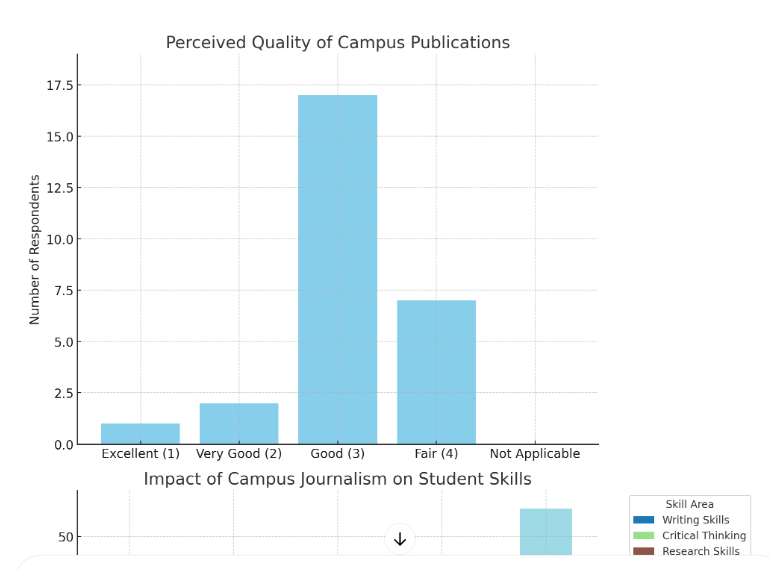
As shown in Figure 2, 56.7% of respondents rated their school publications as “Good”, while 23.3% considered them “Fair.” Only 6.7% perceived the quality as “Very Good”, and a mere 3.3% rated it as “Excellent.” Notably, 0.0% of the participants selected “Not Applicable,” indicating that all respondents were aware of their school publications. These figures reflect a generally positive reception, although there is room for further improvement to elevate the quality to higher standards.
|
|
|
Figure 2. Perceived Quality of Campus Publications |
Effect on Student Skill Development
|
|
|
Figure 3. Impact of Campus Journalism on Student Skills |
Figure 3 illustrates the extent to which campus journalism has influenced the development of five essential student skills: Writing Skills, Critical Thinking, Research Skills, Teamwork, and Confidence.
Writing Skills showed the strongest impact, with 43.3% of respondents rating it as “Significantly improved (5)” and 16.7% as “Improved (4),” totaling 60.0% in the high-impact range.
For Critical Thinking, 40.0% rated it a 5, while 16.7% chose 4, indicating that 56.7% recognized a substantial improvement.
In Research Skills, 30.0% rated it a 5 and 26.7% a 4, suggesting a combined 56.7% perceiving moderate to strong development.
Teamwork saw 30.0% selecting 5 and 43.3% selecting 4, making it the most positively rated skill overall, with 73.3% acknowledging significant or high impact.
For Confidence, 36.7% rated it a 5 and 23.3% a 4, resulting in a combined 60.0% experiencing noticeable growth in self-assurance.
Overall, the data indicate that campus journalism not only supports students in honing their writing skills but also plays a meaningful role in enhancing critical thinking, collaboration, research proficiency, and confidence —all crucial competencies for academic and personal success.
Opportunities on Campus Journalism Practices and the Effective Implementation of the Act
The thematic analysis of the open-ended questions on additional comments and suggestions provided in the questionnaire revealed several key areas where respondents believe improvements are necessary for the development of campus journalism programs. These areas were categorized into six main themes:
Funding and Resource Allocation
Respondents emphasized the critical need for adequate funding to support campus journalism programs. The lack of sufficient financial resources was seen as a barrier to effective student participation and the overall growth of the program. Respondents called for the allocation of funds to cover essential needs such as equipment, training, and participation in events like press conferences.
Examples of Comments
"The department must allocate funds for the school journalism program because without funds, it really affects the participation of students."
"More fund[s,] please!"
"Source out enough funding for training[s] and materials needed in campus journalism."
Training and Development
A strong theme that emerged from the comments was the need for continuous training and professional development for both school paper advisers and student journalists. Respondents emphasized the importance of regular workshops and specialized training, with some suggesting that school paper advisers receive journalistic training at least twice a year.
Examples of Comments
"School paper advisers must undergo journalistic training at least 2 or more times yearly."
"Training for school journalists is also a must..."
"Yearly training and updates for advisers and new advisers."
Infrastructure and Facilities
Respondents indicated that there is a pressing need for dedicated facilities and updated equipment to support campus journalism. Suggestions included providing computers, cameras, and dedicated spaces where student journalists can work effectively. The lack of necessary equipment for radio broadcasting, TV broadcasting, and online publishing was also highlighted.
Examples of Comments
"Should be given a room exclusive for campus journalists with facilities needed in this field."
"Funds, cameras, and SD cards for school journalists."
"Lack of equipment needed for radio broadcasting, TV broadcasting, online publishing..."
Integration into Curriculum
Some respondents suggested integrating journalism into the formal curriculum, either as a core subject or as a specialized program. This integration was seen as a way to enhance the impact and relevance of campus journalism, making it a more recognized and structured part of education.
Examples of Comments
"Journalism should be included in the curriculum or as one subject."
"Hopefully, campus journalism will be integrated into both elementary and secondary teacher education."
Moral Support and Integrity
Another recurring theme was the importance of providing moral support to those involved in campus journalism. Respondents stressed that fostering values such as honesty and integrity should be a priority at all levels of the program, beginning at the school level and extending beyond.
Examples of Comments
"Moral support is needed."
"More focus on honesty and integrity from the school level and up."
Engagement and Participation
Respondents called for greater engagement and participation from both students and teachers in campus journalism activities. This includes ensuring active involvement and motivation to encourage sustained participation. Many suggested that efforts should be made to scout new students with relevant skills and interests in writing and photography, and that trainers should show patience with struggling students.
Examples of Comments
"Scout also freshies who have the skills, interests, and prowess in writing, photography, among others, to be trained."
"Active participation of all teachers."
"During training or workshops, the trainers should extend enough patience for the struggling students."
The analysis highlights key areas of improvement for campus journalism programs, including the need for better funding, regular training, improved infrastructure, integration into the curriculum, and stronger moral support. Engagement from both students and teachers is crucial to the success and sustainability of these programs. These findings provide valuable insights into the challenges and opportunities for strengthening campus journalism in the province.
Bridging the Gap Between Law and Practice
While the CJA mandates the establishment of student publications and promotes press freedom within schools (Republic Act 7079), its implementation often falls short due to various challenges (Tiongson, 2004; Gonzales, 2012; Cainong, 2024). The study addresses this gap by examining the perspectives of School Paper Advisers (SPAs) and journalism teachers, identifying obstacles, and proposing concrete interventions to strengthen campus journalism in the province. This aligns with the broader goal of fostering ethical values, critical thinking, and civic engagement among Filipino youth, as emphasized by Alfaro and Protacio (2025).
One of the key findings is the discrepancy between awareness of the CJA and its actual implementation across different school levels in Mountain Province. This suggests that simply knowing the law is not enough to ensure its effective execution. As Cubillas and Cubillas (2021) noted, the CJA defines campus journalism broadly, encompassing various activities from news writing to photography. However, the study implies that these activities are not consistently or comprehensively integrated into school programs. This echoes previous research in Butuan City, which highlighted a lack of awareness and insufficient support as major concerns. The current study builds on this by pinpointing the specific challenges that contribute to this implementation gap in the province.
The research sheds light on the challenges faced by SPAs and journalism teachers, including limited resources, inadequate training, and heavy teaching loads. These findings corroborate earlier studies that identified similar issues related to editorial policies, SPA qualifications, and financial constraints (Cainong, 2024; Caliao & Bagtas, 2024; Cervantes, 2024; Castino et al., 2025). The study also explores existing support systems, revealing their limitations in addressing these challenges effectively. This underscores the need for more targeted and sustainable support mechanisms that cater to the specific needs of SPAs.
Despite the obstacles, the study confirms the positive impact of campus journalism on students' journalistic skills, critical thinking, and civic engagement. This reinforces the idea that campus journalism serves as a valuable training ground for future journalists and engaged citizens (Cubillas & Cubillas, 2021; Calumaya & Ambayon, 2024). The study suggests that by addressing the identified challenges, schools can unlock the full potential of campus journalism to empower students and foster community transformation, aligning with Sustainable Development Goal 4 (SDG4).
MPSU's Role: A History of Engagement and a Vision for the Future
Mountain Province State University (MPSU) has been actively involved in supporting campus journalism within the province. Analysis of records of requests and correspondence from partner schools to MPSU over the past three years reveals a consistent demand for assistance in training SPAs and budding journalists, providing resource materials, and judging journalism competitions. These requests indicate a recognized need for MPSU's expertise and resources in strengthening campus journalism. MPSU endeavors in journalism include invitations for MPSU faculty to the School's Press Conferences as judges and resource speakers. Furthermore, MPSU faculty are tapped to train journalism teachers on the skills of news and feature writing, photojournalism, and cartooning. This historical engagement, combined with the findings of the current study, underscores MPSU's potential to catalyze positive change in campus journalism practices across Mountain Province.
Indeed, research on extension programs in Higher Education Institutions (HEIs) highlights their significant role in enhancing campus journalism. For instance, the study titled "Impact Assessment of a Campus Journalism Extension Project: Write Here, Right Now" evaluated a training initiative at Laguna State Polytechnic University aimed at developing various journalism skills, including news writing and editorial cartooning. This project not only provided essential training to student journalists but also aligned with the university's vision of community transformation through education. The findings indicated that such extension programs are vital for fostering skills that enable students to engage effectively with their communities and contribute to local discourse (Chavez, 2023).
Another relevant study focused on the literacy extension programs from a college of teacher education, which included a campus journalism component. Participants reported positive outcomes from these programs, noting improvements in their teaching methodologies and student engagement. The campus journalism program was particularly praised for its informativeness, although it faced challenges regarding logistics and content diversity. This underscores the importance of continuous assessment and adaptation of extension services to meet the evolving needs of participants and ensure effective learning experiences (Avelino, 2022). These insights demonstrate how HEIs can leverage extension programs to enhance journalistic skills while addressing community needs.
Furthermore, a study conducted by Central Mindanao University emphasized the necessity for training programs tailored to student journalists' needs. Recommendations included focusing on leadership, time management, and professionalism skills deemed essential for effective journalism practice. The study concluded that structured training initiatives could significantly enhance the capabilities of student journalists, thereby contributing to more robust campus journalism practices across institutions (Abino, 2021). Collectively, these studies illustrate the critical role of HEIs in implementing extension programs that not only develop journalistic skills but also foster a culture of responsible reporting and community engagement.
Conclusion
Acknowledgments: The author expresses sincere gratitude to the respondents from various schools and agencies whose participation and collaboration made this research possible. Their time, insights, and cooperation were invaluable to the study’s completion. Acknowledgment is likewise extended to mentors and colleagues for their guidance and support, as well as to Mountain Province State University (MPSU) for approving the conduct of this research.
Conflict of Interest: None
Financial Support: None
Ethics Statement: The author confirms that the manuscript is an honest, accurate, and transparent account of the study, and that no vital features of the study have been omitted. This study followed all ethical practices during writing.
The Ethical Committee of the Mountain Province State Polytechnic College, Philippines, has approved this study.
Abino, F. S. (2021). Campus journalism training, students’ writing skills, and the status of the official student publication in English. International Journal of Scientific Research in Multidisciplinary Studies, 7(9), 22–28. https://www.isroset.org/pub_paper/IJSRMS/4-ISROSET-IJSRMS-06633.pdf
Aggarwal, Y. P. (2008). Statistics of education (2nd ed.). Sterling Publishers.
Alfaro, P. J. T., & Protacio, A. V. (2025). Construing the worldview of the campus journalists. International Journal of English Language, Education, and Social Sciences, 10(3), 14–27. https://ijels.com/upload_document/issue_files/7IJELS-103202514-Construing.pdf
Avelino, J. M. (2022). Implementation of the special program in journalism of a public secondary school in DepEd Rizal: an evaluation. Psychology and Education: A Multidisciplinary Journal, 6, 616–628. doi:10.5281/zenodo.7497793
Baguio Herald Express Online. (2025). DepEd Tabuk slates 2024 division schools press conference. https://www.baguioheraldexpressonline.com
Cainong, M. D. (2024). Journalistic writing competence and management skills of school paper advisers. Psychology and Education: A Multidisciplinary Journal, 19(4), 437-453. doi:10.5281/zenodo.11077490
Caliao, A. G., & Bagtas, L. (2024). Spotlight: highlighting the success stories of Grade 10 completers of the special program in journalism. Philippine E-Journals, 39(3). https://ejournals.ph/article.php?id=28150
Calumaya, H., & Ambayon, C. M. (2024). Unpacking the tales of award-winning campus journalism coaches. Philippine E-Journals, 40(2). https://ejournals.ph/article.php?id=28294
Castillo, A. R., & Velasco, C. Q. (2025). The lived experiences of school paper teacher-advisers in campus journalism. International Journal of Social Sciences and Humanities Research, 4(7), 1444-1466. doi:10.58806/ijsshmr.2025.v4i7n17
Castino, J. M. P., Pante, R. B., & Daguman, R. J. (2025). Establishing a special program for journalism at spottswood national high school: a feasibility study. International Journal of Research and Innovation in Social Science, 9(2), 421–430. https://rsisinternational.org/journals/ijriss/articles/establishing-a-special-program-for-journalism-at-spottswood-national-high-school-a-feasibility-study
Cervantes, B. M. (2020). Implementation of campus journalism act among the public secondary schools in region III: An evaluation. Global Journal of Human-Social Science: G Linguistics & Education, 20(2), 1–12. https://globaljournals.org/GJHSS_Volume20/3-Implementation-of-Campus-Journalism.pdf
Cervantes, B. M. (2024). Assessment of the implementation of special program in journalism: Standards, performance, and challenges. Philippine E-Journals. https://ejournals.ph/article.php?id=25709
Chavez, A. C. (2023). Impact assessment of a campus journalism extension project: Write here, right now. Polaris Global Journal of Scholarly Research and Trends, 2(1), 72–78. doi:10.58429/pgjsrt.v2n1a124
Congress of the Philippines. (1991). Republic Act No. 7079: An act providing for the development and promotion of campus journalism and for other purposes. https://lawphil.net/statutes/repacts/ra1991/ra_7079_1991.html
Cubillas, A. A., & Cubillas, M. F. (2021). Awareness and compliance with the Campus Journalism Act of 1991 among public schools in Region XI. Journal of Educational Policy and Research, 15(2), 101–115
Cubillas, P. V. M., & Cubillas, E. T. D. (2024). Campus journalism implementation: teachers’ training model: enhancing compliance and awareness of RA 7079 (Campus Journalism Act). Journal of Philippine Education, 15(1), 45–59.
Dadayan, A. A. (2021). Campus journalism practices among state universities of CALABARZON. IOER International Multidisciplinary Research Journal, 3(4), 210–218. https://www.ioer-imrj.com/wp-content/uploads/2022/01/Campus-Journalism-Practices-among-State-Universities-of-CAABARZON.pdf
Dasalla, J. G. B., & Protacio, A. V. (2025). Unveiling the lifeworld of campus journalists in a public secondary school. International Journal of English Language, Education, and Social Sciences, 10(2), 24–37. doi:10.22161/ijels.103.5
Department of Education. (2009). DepEd Order No. 94, s. 2009: revised guidelines on the selection of student-delegates to the National Schools Press Conference (NSPC).
Department of Education. (2018). DepEd Order No. 25, s. 2018: guidelines on the conduct of the National Schools Press Conference and Regional/Division Schools Press Conferences.
Divino, M. A., Jara, M. C., & Mendoza, G. A. (2025). Issues and challenges on campus journalism and impact in school publication: perspectives of principals and paper advisers. International Journal of Innovative Science and Research Technology, 10(3), 112–120. https://www.ijisrt.com/issues-and-challenges-on-campus-journalism-and-impact-in-school-publication-perspectives-of-principals-and-paper-advisers
Espado, A. (2022). Campus Press Freedom Act of 2022: Upholding and promoting campus journalism and press freedom in the Philippines. Philippine Senate. https://legacy.senate.gov.ph/lisdata/3978436290!.pdf
Geanhs, R. T. (2024). Campus journalism as a platform for youth empowerment in Philippine schools. Southeast Asian Education Review, 12(3), 77–89.
Gonzales, R. A. (2012). Campus journalism in the Philippines: legal framework and implementation issues. Philippine Journal of Education, 91(3), 45–55.
Graybeal, G. M., & Sindik, D. (2012). Journalism education matters: impact of student media experience on critical thinking. Journalism & Mass Communication Educator, 67(4), 333–348. doi:10.1177/1077695812458949
Graybeal, G., & Sindik, A. (2012). Journalism students and civic engagement: Is there still a connection? Community Journalism, 1(1), 29–46. https://tccjtsu.com/wp-content/uploads/2012/08/graybealsindik-cj1-2012.pdf
Natividad, A. M. B., & Gapasin, A. R. P. (2021). Public school paper advisers’ assessment on the implementation of the campus journalism act in the Philippines. Journal of Education and Practice, 12(4), 30–42. https://www.dpublication.com/wp-content/uploads/2021/07/A25-907.pdf
Tiongson, N. G. (2004). Freedom of expression and the campus press. Philippine Studies, 52(4), 511–523.
Tura, R. (2025). Assessment of the implementation of special program in journalism (SPJ): basis for an intervention program. Journal of Interdisciplinary Perspectives, 3(3), 36–44. doi:10.69569/jip.2025.002